
Bonsai Pot Size and Depth Guide
Choosing a bonsai pot isn't about giving the roots room to spread the way you would with a houseplant, it's about matching the container to the tree in front of you, right now, at its current stage of development.
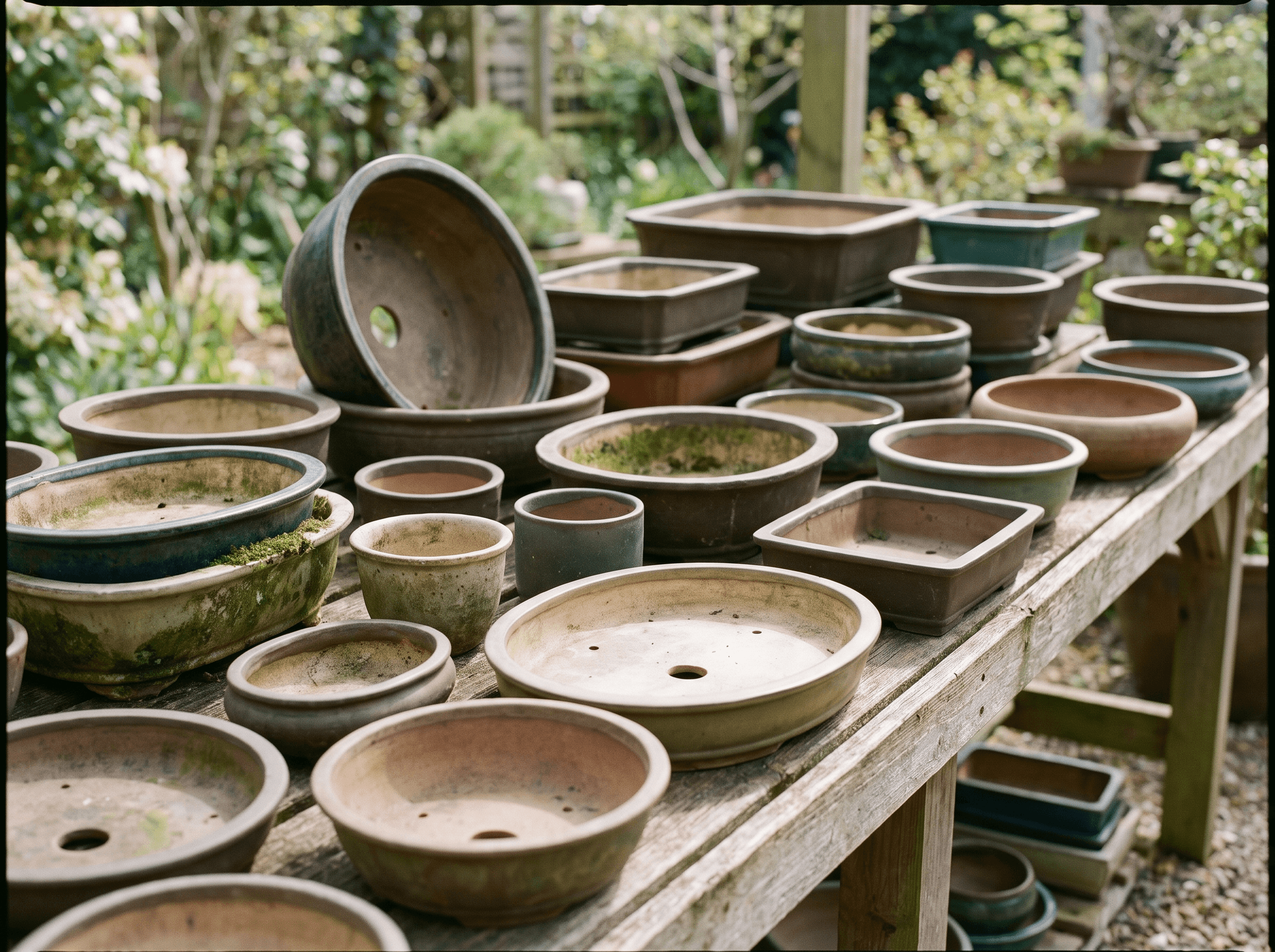
People bring me a tree that's outgrown its pot and ask for something with more room, the way you'd size up a houseplant. I understand the instinct. With houseplants, more soil means less watering and more space for roots to spread, and that reads as kindness. Bonsai runs on a different logic. The pot isn't there to make life easier for the roots, it's there to keep the tree as compact and as healthy as it needs to be at this stage, which means sizing to the tree in front of you, not to some imagined future version of it.
The mechanical reason matters more than the visual one, though the visual one is real too. A pot that's too large for the root mass holds a much bigger volume of moist soil around a comparatively small amount of root. That soil stays wet longer after each watering, and roots sitting in constantly available moisture have little reason to branch out and search for it. The result, more often than not, is a tree pushing long, soft, leggy growth instead of the tight, ramified growth you actually want.
Depth is its own decision, loosely tied to the style you're training toward, and worth separating from the size question entirely. There's also a stage-of-development question a lot of beginners skip past: young, developing material usually doesn't belong in a refined display pot at all, it belongs in a plain training pot first. I'll go through all three.
Why oversized pots can hold refined trees back
For a tree that's past the development stage and being kept in a refined pot, an oversized container is a plausible contributing factor when growth stalls or gets weak and leggy, though it's rarely the only variable and rarely obvious just from looking at the canopy. The soil around the edges of the root ball, the part with no roots in it yet, tends to hold more moisture for longer after watering in a pot that's too big for what's growing in it. Roots near that persistently damp zone have less incentive to branch and search, since water is already sitting there waiting for them. On very young material still in development, a larger container is often the right choice and can work in your favor for bulking up trunk girth quickly, which is one reason this concern applies mainly to trees you're trying to keep compact and refined rather than to material you're still growing out. If a refined tree has sat in the same oversized pot for a couple of seasons with weak, elongated growth, an oversized pot is worth considering as one possible factor alongside watering habits, light, and feeding.
Sizing the pot to the tree
There's no single formula that fits every tree, but the working principle is proportion, not generosity. A pot should frame the tree, not just contain it. For a tree with a spreading canopy, the pot's length often lands somewhere near two thirds of the tree's height, though I treat that as a starting point to eyeball rather than a number to measure precisely with a tape. Width matters too. An oval or rectangular pot is generally a touch narrower than the widest spread of the branches, so the foliage overhangs the rim slightly instead of sitting well inside it. I've corrected pots that were technically within the usual proportions but still looked or performed wrong for that specific tree, so treat the ratios as a starting point and let the tree's actual vigor and appearance confirm or correct it.
How depth follows style
Depth is where style enters the decision more directly than width ever does. Cascade and semi-cascade trees, where the trunk or a major branch drops below the rim of the pot, are traditionally planted in noticeably deeper containers. Part of that is visual balance, a shallow pot under a cascading trunk looks unstable and top-heavy, but there's a practical root argument too, since a cascade is already an awkward shape for the tree to support and the extra depth gives the roots more to work with underneath. Formal upright and broom-style trees sit at the other end, usually in shallow pots that emphasize the vertical trunk line and the symmetry of the crown without competing for attention. Informal upright, slanting, and most other styles fall somewhere in between, and in practice a lot of growers reach for a medium-depth oval or rectangle unless the tree's silhouette specifically calls for deeper or shallower.
Training pots versus display pots
A tree still being developed, still building trunk thickness or working through early branch structure, usually gets nothing from a refined display pot except a slowdown. Most growers use a plain, often larger training pot, sometimes called a grow box, made of wood, plastic, or mica, for this stage. It's cheap, easy to replace as roots fill it, and its extra volume supports the more vigorous growth you actually want while the tree is still being built rather than restrained. The move into a proper display pot, ceramic, glazed or unglazed depending on species and style, comes later, once trunk and primary branch structure are largely set and the work shifts from growing to refining. Put a young, undeveloped tree straight into an expensive display pot and you usually just slow down the development you were trying to speed up.
A practical way to decide
When I'm genuinely unsure, I default smaller and shallower rather than larger and deeper, because a slightly tight pot is a far easier problem to manage than a wet one. Signs a pot is working against the tree include soil staying visibly damp for days after watering, weak or overly long internodes despite good light and feeding, and roots that fill only the outer inch of the pot while the middle stays loose and undeveloped. If you're choosing between two reasonable options and can't decide, go with the one that leaves less empty soil around the existing root mass. You can always size up gradually at the next repot. Correcting an oversized pot usually costs you a season or two of growth you didn't need to lose.
Common questions
How do I know if my current pot is too big for my tree?
Look at how long the soil stays visibly damp after watering and how the roots are distributed through the pot. If the surface is still dark and wet two or three days after a thorough watering, or roots have only filled the outer edge while the center stays loose, the pot is probably oversized for the current root mass.
Does pot depth need to exactly match trunk diameter?
You'll hear an old rule that pot depth should roughly equal the trunk's diameter just above the roots. It's a reasonable starting point for a formal upright in a rectangular pot, but I wouldn't treat it as a strict measurement to hit. Style, root volume, and how the tree actually looks in the pot matter more than matching a number precisely.
Can I put a young, undeveloped tree straight into a nice ceramic display pot?
You can, but I'd generally hold off. Refined pots tend to be smaller and more restrictive than training pots, which slows the vigorous growth you want while a tree is still developing trunk and branch structure. Save the good pot for once that structure is mostly in place.
Is a grow box the same thing as a training pot?
Yes, essentially. Both describe a plain, often larger container, wood, plastic, or mica, used for developing material before it moves into a refined display pot. The plainness is the point, you're optimizing for root growth and easy repotting, not appearance.
How much bigger should a new pot be when I do size up?
Modestly. A common approach sizes up just enough to accommodate a season or two of root growth, not a dramatic jump to something much larger. Repotting is a normal, recurring part of bonsai care, so there's little benefit in overshooting size now just to delay the next repot.
Does pot size matter as much for very small shohin trees?
It matters even more, in a sense, because the margin for error shrinks along with the pot. A shohin container holds so little soil to begin with that even a modestly oversized pot throws off the moisture balance noticeably. Precision in sizing tends to matter more, not less, as the tree gets smaller.
What if my tree's roots have completely filled a pot that's the right size for the style I chose?
That's a normal, healthy reason to repot on schedule, not a sign the sizing was wrong to begin with. Being root-bound in an appropriately sized pot is very different from being crammed into an undersized one. If growth and vigor still look good, it's usually just time for a routine repot rather than a bigger pot.
Should a pot I'm about to move a tree into always be unglazed for pines and glazed for flowering or deciduous trees?
That's the general convention and it's a reasonable default, unglazed earth tones for conifers, glazed colors for flowering and deciduous species, but it's a matter of traditional aesthetic pairing rather than a rule about tree health. Size and depth affect the tree's growth directly. Glaze is really about what looks right together.
You might also like
General guidance based on 20+ years of practice. Every tree and every climate is different — when in doubt, ask us.