
Fungus gnats: tiny flies in bonsai soil
Small dark flies hovering around the pot, especially when you water, are almost always fungus gnats, more of a nuisance than a real threat in most cases.
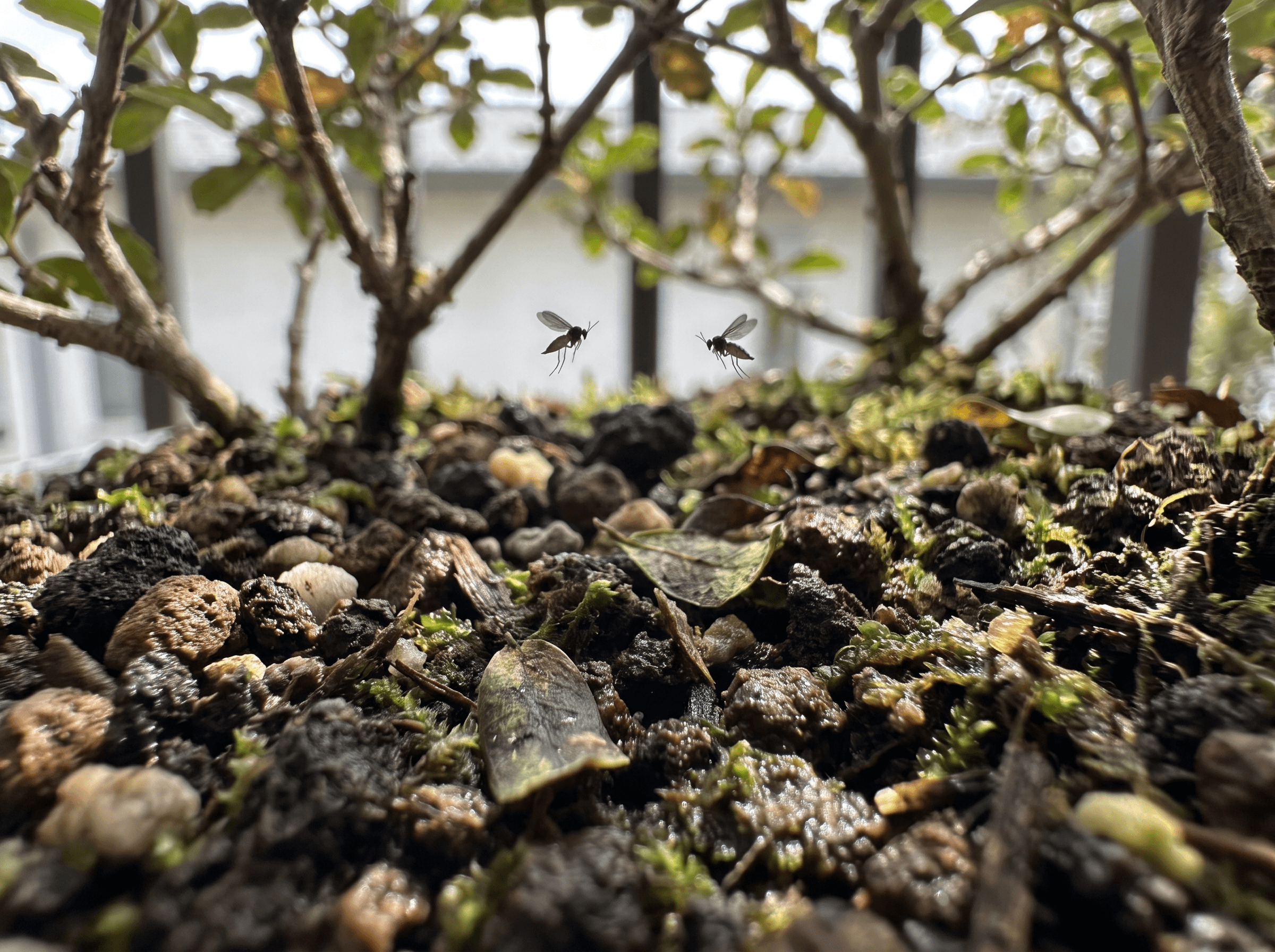
Fungus gnats are the pest I get asked about most from people who've just brought a tree indoors for winter, or who've switched from checking the soil before watering to watering on a fixed schedule instead. They're small, dark, mosquito-shaped flies, but they're weak fliers and clumsy, more likely to stumble around near the pot than to actually go anywhere. If you've ever waved your hand near a houseplant and watched a little cloud rise up and immediately settle back down, that's them.
You'll usually notice them right when you water, or if you poke a finger into the top of the soil to check moisture. That disturbance is enough to send the adults up off the surface, which is also the easiest way to confirm what you're dealing with before you start treating anything. The adults themselves live only about a week, but a female can lay well over a hundred eggs in that time, straight into the top layer of moist soil, and the whole cycle from egg to flying adult can finish in under a month indoors. That's why a handful of gnats on Tuesday can look like a small cloud by the following week if the soil stays consistently damp. It's also why gnats tend to show up in clusters rather than one tree at a time: once conditions are right on your bench, several pots start hosting them within days of each other, which can make it look like a sudden infestation when really it's just several small populations reaching visible numbers at once.
For a healthy, established bonsai, fungus gnats are mostly an annoyance rather than a genuine threat. The adults don't feed on the tree at all, and the larvae are primarily after decaying organic matter and the fungi that break it down in the soil, not living wood. Where I do pay closer attention is on young seedlings, fresh cuttings, or a tree that's just been repotted and is running on a small, tender root system, since a heavy larval population in that situation can nibble at fine root hairs and add stress the tree doesn't need. On a mature, vigorous bonsai in a well-draining mix, I mostly just find them irritating rather than worrying.
Likely causes
Fungus gnat larvae in wet soil
How to tell: Tiny flies lift off the soil surface the moment you disturb it or water the pot, then settle back down within a minute or two once things go quiet. Dig into the top half inch of soil and you'll often find the larvae themselves: thin, clear to whitish, legless little worms with a shiny black head capsule, moving through the damp organic matter rather than the drier mineral particles underneath.
The fix: Let the soil surface dry out more between waterings. Drying that top layer out greatly reduces larval survival and interrupts the life cycle, though a few larvae or pupae can persist a little longer than the adults do, so don't expect an instant kill; only the mature root zone below needs consistent moisture. A layer of coarse grit, chicken grit, or fine gravel roughly half an inch deep spread over the surface also helps a great deal, because it dries fast and gives the adult females nowhere damp and inviting to lay eggs in the first place. Just avoid material so coarse it leaves gaps down to the soil underneath.
Overly organic or fine soil mix
How to tell: The substrate feels dense and holds water for days rather than draining through within a few hours of watering. If you press a finger into it, it feels more like potting compost than a proper bonsai mix, and you may notice the surface staying dark and damp-looking well after the rest of the tree has dried out.
The fix: Consider repotting into a coarser, more mineral bonsai mix at the next appropriate season for that species, since a free-draining mix simply gives gnat larvae far less organic material and moisture to work with. In the meantime, cut back on frequency rather than volume when you water, giving the pot a thorough soak but then leaving it alone until the top layer is genuinely dry rather than just cool to the touch.
Eggs or larvae introduced with bagged soil or organic amendments
How to tell: Gnats appear within a week or two of repotting, adding a bag of potting compost as a top dressing, or bringing home a tree that came in a soft, peat-heavy nursery mix. There's often no history of gnats on that particular tree before, which points to the material rather than your watering habits.
The fix: Treat any bagged soil, compost, or organic top-dressing as a possible carrier, and be cautious with cheap, moisture-retentive mixes marketed for houseplants rather than bonsai, since they're usually loaded with fine peat and compost that gnats love. Let unused mix dry out thoroughly before you use it, and if you want stronger sanitation, seal it in a bag and let it solarize in full sun for several weeks, or buy a pasteurized mix instead. A quick day or two in the sun on its own isn't reliable enough to kill off most eggs and larvae.
How to prevent it
Almost everything with fungus gnats comes back to moisture at the soil surface, so the single biggest habit to build is checking that top layer before you water rather than watering on autopilot. Stick a finger or a moisture meter into the first inch of soil, and if it's still damp, wait another day, particularly once a tree comes indoors for winter and its water use drops. Pair that with a mix that drains quickly and doesn't hold a soggy layer near the surface, and a thin mineral top dressing on pots that seem prone to it. If you're bringing home new trees or new bags of soil regularly, give them a quick look and, where practical, a short quarantine before they sit next to the rest of your collection, since that's how gnats most often get introduced in the first place. A few yellow sticky cards tucked near your benches, even when you don't currently have a problem, will tell you within days if a new batch has arrived, long before you'd notice them by eye. I keep a couple up year round on my own indoor benches for exactly that reason, and replace them the moment they start filling up rather than waiting until a card is completely covered.
Common questions
Do fungus gnats harm my bonsai?
In most cases, no, they're more of an annoyance than a genuine threat, since the adults don't feed on the tree and the larvae mostly break down decaying organic matter in the soil. The exception is a heavy infestation on a young seedling, fresh cutting, or a recently repotted tree with a small root system, where the larvae can nibble at fine root hairs and add stress the tree doesn't need.
Will sticky traps get rid of them?
Yellow sticky traps catch the adult flies effectively and are great for monitoring how bad an infestation is, but they don't touch the larvae living in the soil, which is where the population is actually coming from. Use them alongside letting the soil dry out and treating the top layer, not as a standalone fix.
How long does it take to get rid of fungus gnats once I start treating?
Because eggs and larvae are already developing in the soil when you start, expect to see adults for another two to three weeks even if you're doing everything right, since you're only stopping new eggs from being laid, not clearing out what's already there. Consistency matters more than intensity here; a dry soil surface kept up for a full month usually breaks the cycle completely, whereas going hard for a few days and then slipping back into old watering habits just lets the next generation pick up where the last one left off.
Should I let the soil dry out completely to kill them off?
You want the surface dry, roughly 1cm to half an inch or an inch below the top depending on your pot, not the whole root ball, since bonsai pots are often shallow enough that roots occupy much of that depth. Adjust exactly how deep you check to the pot's depth and the species, and never let the root mass itself dry out completely, as it still needs consistent moisture below that surface layer to stay healthy. Letting the entire pot dry out to kill gnats can do more damage to the tree than the gnats ever would, so focus the dryness on the surface where the eggs and young larvae actually live.
Can fungus gnats spread from one bonsai pot to another nearby tree?
Yes, the adults fly, weakly, but well enough to move between pots that are sitting close together on the same bench, especially if several of them have damp organic-rich soil. If one pot is clearly the source, it's worth moving it away from the others while you deal with it, particularly indoors over winter where everything sits close together anyway.
Is BTI (Bacillus thuringiensis israelensis) worth using for bonsai specifically?
It's one of the more reliable options if you want something beyond just drying out the soil, since BTI targets the larvae directly and is sold as a soil drench or dunks you dissolve in your watering can. It's selective enough not to harm the tree or beneficial insects, though I'd still pair it with letting the surface dry between waterings rather than relying on it alone, since a soil that stays constantly wet will just attract a new batch of egg-laying adults regardless.
You might also like
General guidance based on 20+ years of practice. Every tree is different — when in doubt, ask us.