
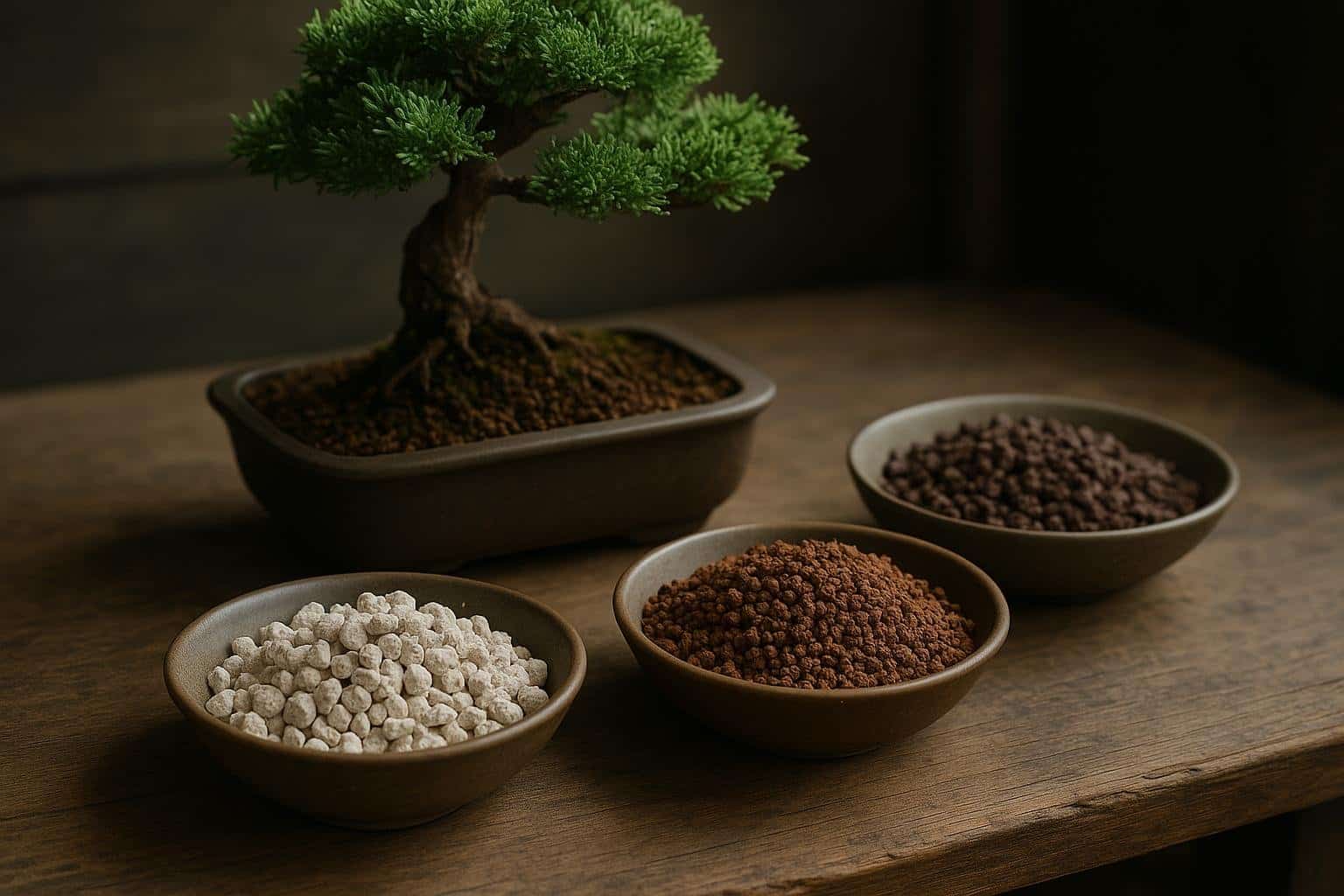
The bonsai soil mix is one of those topics that looks simple from the outside and turns out to be one of the most consequential choices a grower makes. The substrate is where the roots live. A wrong mix can kill a tree in one season, and a right mix can carry a healthy bonsai for decades with minimal intervention.
After more than twenty years growing bonsai in Southern Italy, I have ended up with a small set of materials I trust and a handful of ratios I adjust depending on the species and the pot. There is no single perfect mix. There is a mix that works for what you are growing and where you are growing it.
This article walks through the materials I use, the ratios I default to, and the mistakes I keep seeing repeated. Nothing fancy, just what has worked for me season after season.
Why bonsai soil is different from regular potting soil
Regular potting soil is designed to hold water. A bonsai needs the opposite. The pot is shallow, the root mass is constrained, and the plant lives in this tiny ecosystem for years. Water-retentive soils suffocate roots and rot bonsai in a few seasons.
A good bonsai soil mix has three jobs at once: drain freely so excess water leaves quickly, hold a small amount of moisture so the roots have something to drink between waterings, and maintain air pockets so the roots can breathe.
These three requirements pull in opposite directions, and the art of mixing bonsai soil is finding the balance for each species. A juniper needs more drainage than a maple. A pine wants more aeration than a ficus.
The three main components of bonsai soil mix
I build almost every mix from three materials: akadama, pumice, and lava rock. Each plays a specific role.
Akadama is a clay granulate from Japan, baked into hard but porous pellets. It holds moisture, releases it slowly, and breaks down gradually over a few years. The breakdown is intentional: as akadama softens, it encourages fine root development. Hard-quality akadama lasts two to three repotting cycles before it needs replacement.
Pumice is a volcanic glass, light and porous, with excellent drainage. It holds some moisture in its pores but releases it readily. Pumice does not break down, so a mix with high pumice content stays structurally stable for many years. In hot Mediterranean climates, pumice is invaluable because it does not compact.
Lava rock, particularly red or black lava granules, adds drainage and structure. It is denser than pumice and gives the substrate a stable backbone. Lava also holds some heat, which conifers appreciate.
Together, these three create a substrate that drains well, breathes, and holds enough moisture for healthy root development. The proportions are what change between species.
Ratios I use for different species
For most deciduous broadleaves like maple, hornbeam, beech, and Chinese elm, I use roughly 50% akadama, 30% pumice, 20% lava. This mix holds enough moisture to support the larger leaves and faster summer transpiration.
For pines and junipers, I shift toward more drainage: 30% akadama, 40% pumice, 30% lava. Conifers hate wet feet, and this mix protects them from root rot during long Mediterranean autumns and winters.
For ficus, olive, and other Mediterranean-adapted species, I use roughly 40% akadama, 40% pumice, 20% lava. These plants are robust and tolerate a wider range of moisture conditions.
For very young plants in training, where I want fast growth, I use a richer mix with more akadama or even a small percentage of organic compost. Mature trees in display pots, however, need the leaner mineral mix to stay refined.
Particle size matters as much as ratio
Beyond what you use, how big the particles are makes a real difference. For small pots and shohin bonsai, I use small granules around 2 to 4 mm. For medium bonsai, 4 to 8 mm works well. For larger trees in bigger pots, 6 to 10 mm gives better drainage.
Mixing particle sizes within a pot is rarely a good idea. The fine particles settle to the bottom and create a dense, water-logged layer. I sieve my mix to a consistent size before potting.
Dust and very fine particles are the enemy. They clog the pores and ruin drainage. I always wash and sieve substrates before use, removing anything smaller than 1 mm.
Adapting to local climate
In Southern Italy, the long hot summers mean substrates dry out fast. I lean toward mixes with higher akadama for moisture retention, especially for trees in full sun. In cooler climates, the same plant would do better with more pumice and less akadama.
The pot size matters too. Small pots with little soil volume need more akadama to compensate for fast drying. Large pots with deep root masses can use leaner mineral mixes without water-stressing the plant.
If you want to dig deeper into how watering interacts with substrate choice, my olive bonsai care guide covers many of the same principles applied to a specific species.
What I avoid in a bonsai soil mix
I avoid garden soil and regular potting compost. Both compact over time and suffocate roots. The short-term moisture they hold is not worth the long-term damage.
I avoid sand. Sand particles are too small, they clog drainage, and they offer no porosity. The old “sand for drainage” advice belongs to outdoor gardening, not bonsai.
I avoid peat-based mixes for the same reason. Peat holds water like a sponge but releases it poorly when dry. It also turns hydrophobic when it dries out completely, becoming nearly impossible to rewet.
I avoid pre-mixed “bonsai soil” sold in supermarkets. The quality is highly variable, the particles are often too fine, and the price-per-volume is usually worse than buying components separately.
Common mistakes I see
The first mistake is using too much akadama in conifer mixes. Junipers and pines suffer in retentive substrates, and a maple-style mix will weaken them in two seasons.
The second mistake is not sieving the substrate before potting. The fines that come with bagged materials are often a third of the volume, and they ruin the drainage.
The third mistake is mixing dry and wet substrate components together. The akadama absorbs moisture differently than pumice, and an unevenly mixed substrate creates wet pockets and dry pockets. I always pre-moisten everything before mixing.
I see many beginners trying to use cheap akadama from unknown sources. The result is granules that break down in one season, and a pot full of mud by autumn. Quality akadama is more expensive but lasts years longer.
Finally, do not change the substrate every year. Akadama, pumice, and lava do not need yearly replacement on healthy bonsai. Full substrate changes every 2 to 4 years for deciduous trees, and every 3 to 5 years for conifers, are plenty.
Frequently asked questions
Can I make bonsai soil at home without buying akadama?
You can, but the result is rarely as good. Pumice alone makes an acceptable mix for very vigorous species, but more refined trees benefit from akadama’s moisture-holding properties.
How much does a good bonsai mix cost?
For quality components, expect to spend 1.5 to 3 euros per liter of finished mix, depending on the proportions. A medium bonsai pot needs about 1 to 2 liters of substrate.
Can I reuse old bonsai soil after repotting?
Sift it carefully to remove fines and broken-down particles. Healthy pumice and lava can be reused. Akadama that has broken down to mud is finished.
Do I need different soil for indoor bonsai?
Generally no. The same mineral-based mixes work indoors. Watering frequency differs, but the substrate principles are the same.
How do I know if my soil mix is right?
Watch the watering behavior. Water should drain through within 10 to 15 seconds when poured. If it pools on top, the mix is too fine or compacted. If the substrate dries out within hours of watering, it might need more akadama.

Roberto Liccardo is a bonsai artist and nurseryman based in Calabria, Italy, with over 20 years of hands-on experience in bonsai cultivation, styling, and sourcing. He travels to Japan to select trees directly from specialist growers and runs WeBonsai, an online nursery shipping handpicked bonsai across Europe. Passionate about both the living art of bonsai and the technology that brings it to a wider audience, Roberto combines traditional Japanese techniques with a modern approach to e-commerce, packaging, and customer care.
He is also a member of Bonsai Calabria, where he actively contributes to the association’s digital presence by managing its websites and online communication.