
Wind and Summer Storm Protection
A summer storm here rarely announces itself gently, it's usually still and stifling and then wind and heavy rain arrive within the same twenty minutes.
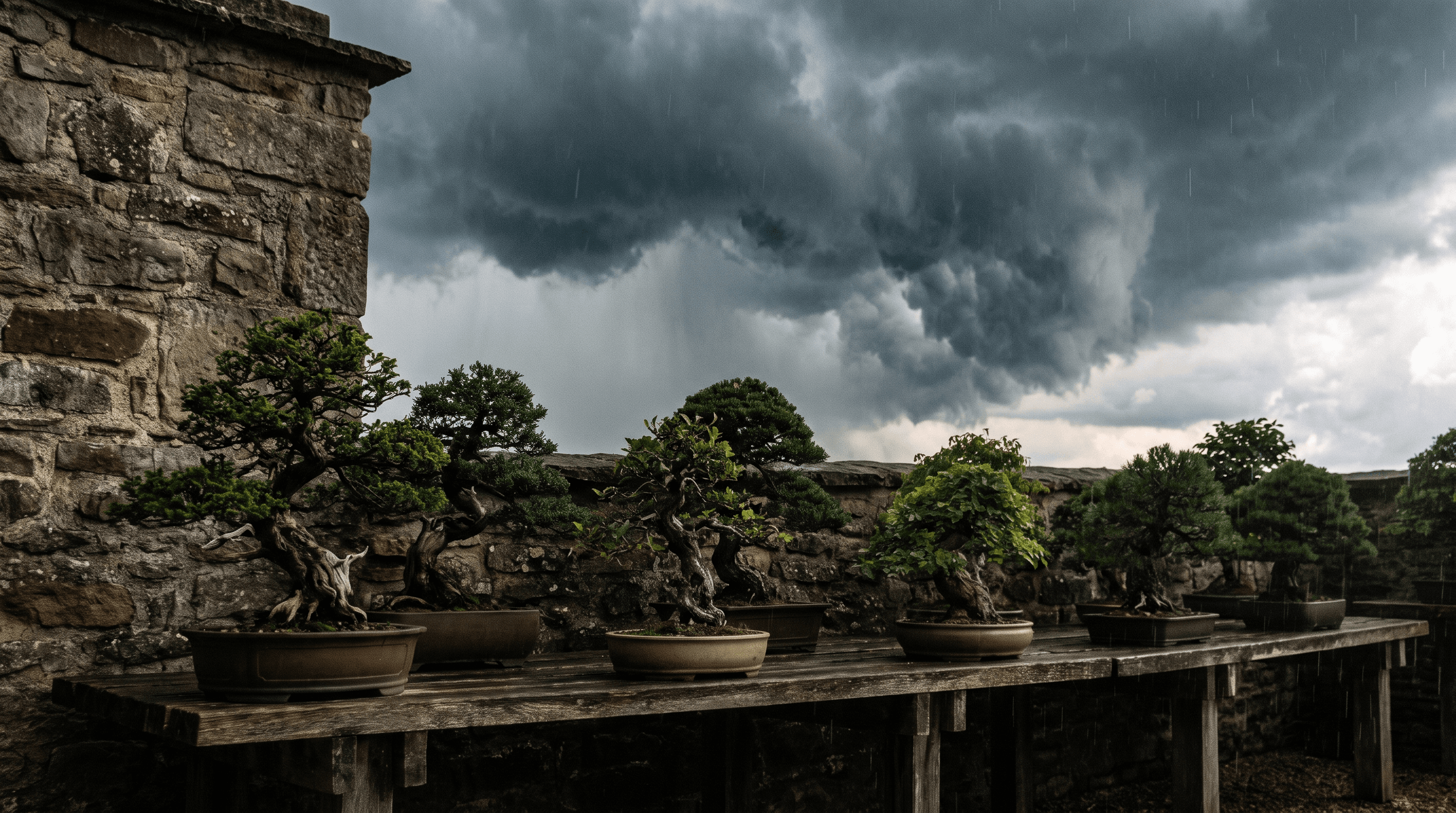
Our summer storms are a different animal from the steady autumn rain most people picture when they hear the word. After weeks of heat, the air builds up pressure and then breaks all at once, often in the early evening, with gusts that can knock over an unsecured pot and rainfall that dumps more water in half an hour than a tree normally gets in a week of hand watering. I've lost branches to these storms, and once, years ago, an entire trained pine to a gust that caught it broadside on an exposed stand.
The mistake I see most is treating wind and rain as separate risks. They arrive together in a summer storm, and the response to one can make the other worse. A pot moved to a sheltered wall corner for wind protection might now sit under an eave that funnels runoff straight into the soil, overwhelming drainage that was fine in open rain. You have to think about both at once.
This isn't about building a permanent storm shelter. Most of what protects a collection through summer storm season is quick, temporary, and reversible, done in the hour before a forecast storm arrives or, more realistically, in the five minutes after you notice the sky changing.
Securing pots before the wind picks up
Shallow bonsai pots are light relative to their surface area, and a mature tree with a full canopy acts like a sail. On an exposed balcony or open bench, that combination tips over easily in gusts that wouldn't bother a normal potted plant. I keep a few sandbags and some soft ties on hand through summer specifically for this. Grouping pots low and close together, rather than spread out on individual stands, also helps, since a fallen neighbor is a lot less damaging than a tree that tips from height onto a hard surface. For anything on a raised stand, I either bring it down to bench level before a forecast storm or tie the stand itself to something fixed.
Temporary shelter for the most exposed trees
Not every tree needs shelter for every storm, most established specimens in reasonable pots handle a passing summer storm without issue. But recently repotted trees, anything with fresh wiring under tension, and trees on the most wind-exposed edge of a terrace are worth moving under an overhang or against a solid wall when a serious storm is forecast. I don't mean bringing them indoors, just out of direct line for both the strongest gusts and the heaviest rain impact. A wall that blocks the prevailing wind direction does more good than most people expect, since it's the sustained gusts, not a single strong one, that tend to loosen roots in a pot that isn't fully settled.
Checking drainage before, not after, the downpour
A summer storm can drop more rain in an hour than your normal watering schedule delivers in days, and a drainage hole that was adequate for hand watering can become a bottleneck under that volume. Before storm season really gets going, usually late June for me, I go through the collection and clear any drainage holes that have gotten partially blocked by root growth or compacted substrate over the season. A pot that can't drain fast enough during a downpour ends up waterlogged for hours afterward, and roots that have adjusted to a dry summer watering rhythm don't handle sudden waterlogging well, even briefly.
After the storm passes
Once it's over I walk the whole collection, not just the trees I sheltered. Check for pooled water that hasn't drained within an hour or two, check pots for wobble or tilt that suggests the root ball shifted, and look at wired branches for stress at the wire points where wind would have put the most leverage. Broken branches from a genuine gust are usually a clean snap rather than a tear, and those wounds should be cleaned up properly rather than left ragged. Give the whole bench a full day before assuming everything is fine, some root disturbance from a tipped pot doesn't show as leaf stress until a couple of days later.
Common questions
How do I know if a storm is going to be bad enough to warrant moving my trees?
I watch for the combination of a forecast wind warning and heavy rain together, not either alone. A windy but dry evening is usually fine left as is for most trees. It's the combination, plus any tree that's recently repotted or freshly wired, that pushes me to move things rather than just wait it out.
Should I bring my bonsai indoors during a summer storm?
Rarely, and only for the most vulnerable specimens. Most established outdoor bonsai are fine with temporary shelter against a wall or under an overhang rather than a full move indoors, which can shock a tree that's acclimated to outdoor summer conditions. Indoors is a last resort for something like a very recently repotted tree in an exposed spot.
My pot tipped over in a storm, what should I check first?
Check whether the root ball itself shifted inside the pot, not just whether the pot fell. Gently confirm the tree is still seated firmly in the substrate, repack loose soil around the base if needed, and hold off on fertilizing or heavy watering for a few days while you watch for any delayed stress signs.
Can heavy summer rain cause root rot even in well-draining substrate?
It's possible if drainage holes are partially blocked or if the volume simply outpaces what even good substrate can move through in an hour. This is exactly why checking and clearing drainage holes before storm season, rather than after a problem shows up, matters more than people think.
Is it worth building a permanent windbreak for my collection?
For a collection on a consistently exposed rooftop or balcony, a semi-permanent screen or trellis on the prevailing wind side is a reasonable investment. For most home setups, though, quick temporary measures before forecast storms cover the actual risk without the cost and hassle of a permanent structure.
How long after a storm should I wait before doing normal maintenance?
I give trees a day or two to settle before pruning, wiring, or repotting anything that went through a rough storm, even if it looks fine on the surface. Watering and basic checks can continue as normal, it's the more invasive work I hold off on until I'm confident there's no hidden root disturbance.
Do wired branches need extra attention after a windy storm?
Yes, check the wire points specifically. Wind puts real leverage on a wired branch, especially near where the wire anchors, and I've seen wire bite into bark that wouldn't normally have shown stress yet simply because a gust flexed the branch against it repeatedly during a storm.
You might also like
General guidance based on 20+ years of practice. Every tree, climate, and year is different — when in doubt, ask us.