
Humidity Tricks for Summer Bonsai
Southern Italian summer air is dry enough to stress humidity-loving species even when the pot itself is perfectly watered.
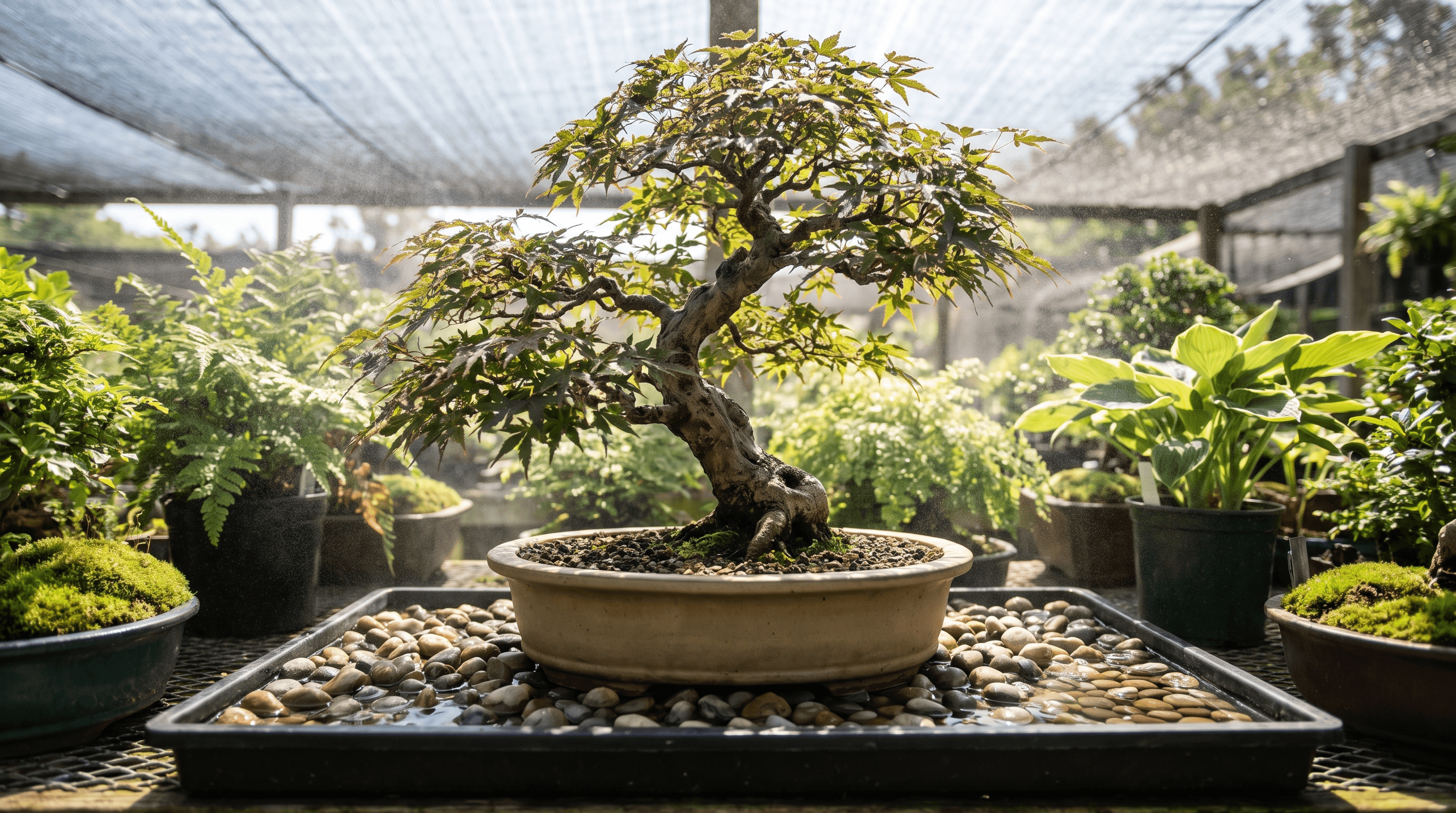
By July the air here can sit at thirty percent humidity for weeks, sometimes less on the windier afternoons, and that catches out a lot of growers who assume watering is the whole story. It isn't. A tree can have moist soil and still be losing water through its foliage faster than its roots can replace it, and that gap shows up as tip burn, curled leaf edges, or needles that go slightly grey before they go brown.
I get asked constantly whether a given tree needs more humidity or more water, and the honest answer is that most people reach for the watering can when a humidity tray under the pot would help more. It's not a fix for serious stress on its own, more a small, local supplement to good watering. Ficus, azalea, some maples, and a good number of tropical and subtropical species that do fine in a humid coastal spring can start to struggle when the air itself dries out, though ficus in particular tolerates low humidity better than people assume thanks to its thick, waxy leaves.
None of what follows replaces good watering practice. It sits alongside it. Think of humidity management as addressing what happens above the soil line, while your watering schedule handles what's happening below it.
Humidity trays actually work, if you build them right
A shallow tray filled with gravel or lava rock, topped up with water that sits below the level of the pot's feet, raises the local humidity right around the foliage as it evaporates through the day. The pot must never sit directly in standing water, that's a drainage problem waiting to happen, not a humidity fix. I use trays under my ficus and azalea benches from May through September and refill them most mornings, since a shallow tray in full sun can go dry by early afternoon. The effect is local and modest, a few points of relative humidity right at canopy level, but for species with thin or tender foliage that's often the difference that matters.
Grouping pots changes the microclimate more than people expect
Trees release water vapor through their leaves constantly, and when you cluster several pots close together on a bench, each one is partly breathing the humid air the others just gave off. I noticed this years ago moving a struggling ficus from an isolated spot on the terrace into the middle of a group of six other pots, no other change, and within two weeks the new leaf tips stopped browning. It's not a huge shift in absolute terms, but combined with a tray underneath it adds up. Just leave enough space between pots for airflow, since crowding them too tightly with no air movement invites fungal problems, which is its own kind of trouble.
Morning misting, not midday misting
Misting the foliage gives a real but brief humidity bump, more a supplement to a tray or grouping than a central tool on its own. I mist early, before eight, while the air is still cool and the water has time to evaporate slowly rather than sitting on leaves through the hottest hours. Misting at midday under direct sun does very little for humidity, since the water evaporates within minutes in full sun and heat, so it's mostly wasted effort rather than a genuine humidity boost. Evening misting works reasonably well too, but I still lean toward mornings simply because it's easier to remember before the day gets busy.
Telling a humidity problem from a watering problem
This is where most people get stuck, and it's worth being systematic about it. Check the substrate first, a centimeter or two down, not just the surface. If it's genuinely dry, that's underwatering, full stop, and no amount of misting fixes it. If the soil is moist or even properly damp and you're still seeing crisp brown leaf margins, curling that starts at the tips and edges rather than the whole leaf wilting, or new growth that emerges already looking stressed, that pattern often points to humidity or heat stress rather than root moisture, though root problems, salt buildup in the substrate, and plain sun scorch can produce similar edge burn, so treat it as a strong lead rather than a certainty. Wilting where the whole leaf goes limp and the soil is dry is underwatering. Crisping at the margins with moist soil underneath is often the air rather than the water, and worth a fresh look if a humidity fix doesn't help within a week or two.
Common questions
Which bonsai species actually need extra humidity in summer?
Ficus, azalea, some tropical species like Schefflera or Serissa, and certain maples with thinner leaf tissue are the ones I watch most closely, though ficus tolerates dry air reasonably well thanks to its thick, waxy leaves and usually only struggles in a genuine heat spell. Junipers, pines, and most true Mediterranean natives generally need far less humidity support, since they're adapted to conditions closer to our dry summer air.
Can I mist my bonsai too often?
You can mist too often in the wrong window more than you can mist too often in general. Repeated misting during the hottest midday hours does little good, since the water evaporates within minutes and adds almost nothing to ambient humidity. A couple of morning mistings a day during a heat spell is reasonable for humidity-loving species, more than that is mostly wasted effort.
Do humidity trays attract pests or mosquitoes?
Standing water can attract mosquitoes if it sits still for several days, which is one more reason to empty and refresh trays regularly rather than letting them stagnate. I scrub and refill mine roughly weekly through summer, more often during a heat spell. Gravel-filled trays that drain and dry out partially between refills are less of a concern than a tray of plain standing water left untouched.
Is grouping pots together bad for airflow and disease risk?
It can be if you pack them too tightly. I leave a hand's width or more between pots even when grouping for humidity, enough that air still moves through the group. Dense, still, humid air around foliage with no circulation is exactly the setup that favors fungal issues, so the goal is raising ambient humidity slightly, not creating a stagnant pocket.
My tree has moist soil but the leaves are still crisping at the edges, what's going on?
That pattern, moist substrate with marginal leaf crisping rather than whole-leaf wilting, usually points to a humidity or heat stress issue rather than underwatering, though root problems and plain sun scorch can look similar. Check whether the tree is humidity-sensitive, add a tray or move it into a group of other pots, and reassess after a week rather than reaching for more water.
Do humidity trays and misting help with heat stress too?
Indirectly. Raising humidity slows transpiration losses, which can ease some of the strain during a heat spell, but it doesn't replace shade or airflow as the primary fix for genuine heat stress. Treat humidity management as one tool alongside shading and good ventilation, not a substitute for either.
Should indoor bonsai get the same humidity treatment as outdoor ones in summer?
Indoor trees, particularly ficus kept indoors year round, often need it more, since air conditioning strips humidity from indoor air just as effectively as our dry outdoor summer does. A tray under the pot and occasional grouping with other houseplants helps indoor specimens the same way it helps outdoor ones on a terrace.
You might also like
General guidance based on 20+ years of practice. Every tree, climate, and year is different — when in doubt, ask us.