
Balcony and Rooftop Summer Bonsai Care
A balcony bonsai isn't just outside in summer, it's outside plus a wall radiating heat back at it plus wind that a ground-level garden never sees.
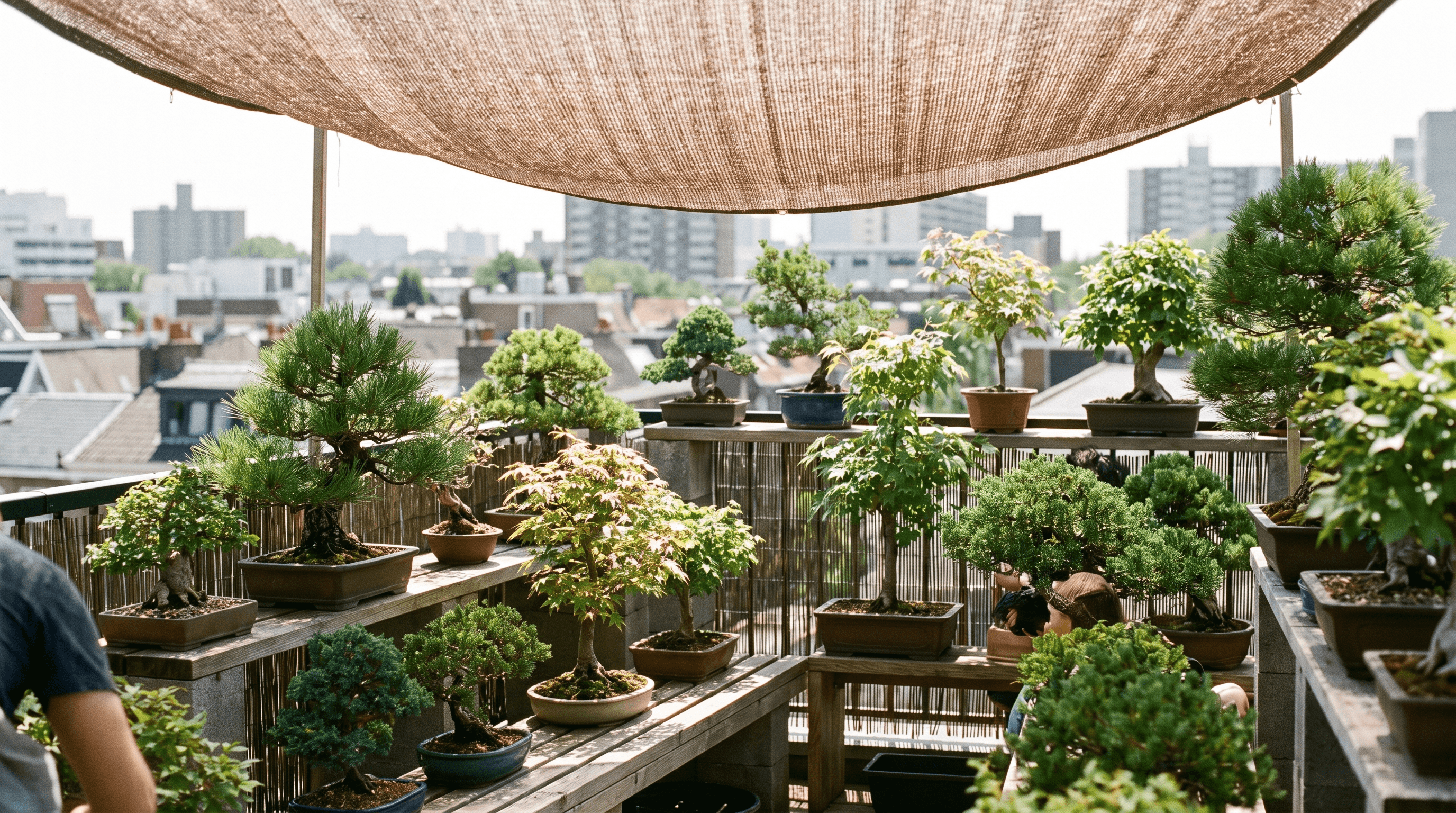
I keep a good part of my own collection at ground level with real soil and surrounding vegetation nearby, but I also help a lot of clients here in the region manage trees on apartment balconies and rooftop terraces, and summer is where the two setups diverge most sharply. Everything that's already hard about summer bonsai care gets amplified up there: faster drying, stronger wind, and heat coming at the pot from more directions than just the sun overhead.
The physics of it are simple once you see them laid out. A ground-level garden has soil around it holding moisture and moderating temperature, and often some shelter from surrounding plants or structures. A balcony has a concrete floor and a wall or railing, both of which absorb heat through the day and release it slowly into the evening, right around your pots, long after direct sun has moved off them.
None of this means balcony or rooftop bonsai can't thrive in summer, plenty of mine do. It means the margins for error are tighter and the checks need to happen more often.
Reflected and radiated heat from walls and pavement
A sun-facing wall, especially a darker one, absorbs heat through the day and keeps radiating it back out well into the evening, and a lighter wall adds reflected light on top of whatever direct sun is already hitting the pot. Concrete or tile flooring does the same thing from below, absorbing heat through the day and releasing it slowly, which means a pot near a south-facing wall on a rooftop can be experiencing meaningfully higher temperatures than the ambient air reading would suggest. In my experience, a pot sitting directly against a sun-facing wall runs noticeably warmer than the same pot moved even a short distance away. On a balcony or rooftop, treat the wall and floor as active heat sources through summer, not neutral background, and keep pots elevated slightly off hot tile or concrete with simple risers or a slatted stand rather than sitting flush against it.
Wind exposure is stronger and more constant at height
Ground-level gardens usually have some windbreak nearby, a fence, a hedge, neighboring buildings. Balconies and rooftops often don't, and wind exposure tends to increase with height and open exposure, which means a tree that would sit calmly in a ground garden can be dealing with near-constant airflow several floors up. That wind accelerates drying on top of the heat that's already working against you, and it's also the reason pot security matters more up there, a lighter shallow pot on an exposed rail-mounted stand is genuinely more likely to tip in a gust than the same pot at ground level.
Watering has to track faster drying, not your usual schedule
The combination of reflected heat and stronger wind means substrate on a balcony or rooftop dries noticeably faster than the same pot would at ground level, sometimes needing water twice as often during a real heat spell. I tell clients to actually check the soil rather than trusting a schedule that worked fine last summer or that works for a friend's ground-level collection, since the drying rate up there is a different problem entirely. Learning to read the substrate directly, the simple finger test a couple of centimeters down, done daily during peak summer rather than every couple of days, is what actually catches this before the tree shows visible stress; a moisture meter can be a helpful extra check, but it's not a substitute for that habit.
Building shade and airflow into a space that has neither by default
A ground garden often has natural dappled shade from surrounding trees. A balcony usually has full sun or full shade with nothing in between, so creating filtered light artificially matters more up there. A simple shade cloth rigged over the worst-exposed hours, or repositioning pots to catch shadow from a railing or umbrella during peak afternoon sun, does real work. Airflow, on the other hand, is often not the problem up there, in many exposed balconies if anything it's excessive, so the goal is more about blocking the harshest direct heat while still letting the wind that's already present do its job of preventing stagnant, overly humid pockets around the foliage. A more sheltered or partly enclosed balcony can be the exception, where stagnant heat pockets are the actual issue, so it's worth judging your own space rather than assuming excess airflow is automatically the case.
Common questions
Is it harder to keep bonsai alive on a balcony than in a garden in summer?
It takes more attention rather than being fundamentally harder. The main added factors are reflected heat from walls and pavement and stronger wind at height, both of which mean faster drying and less margin for a missed watering day, but with regular checking a balcony collection does just fine through summer.
Should I put a barrier between the pot and a hot tile floor?
Yes, elevating pots even a few centimeters off hot tile or concrete with simple risers, a slatted wooden stand, or pot feet reduces the heat transferred up into the substrate from below, which matters more than people expect on a south-facing balcony through the hottest part of summer.
How much more often should I water balcony bonsai compared to ground-level ones?
There's no fixed multiplier since it depends on sun exposure, wall reflection, and wind at your specific balcony, but checking daily rather than every two or three days during a heat spell is the safer default. Some of my clients' balcony pots need water nearly twice as often as the same species would at ground level nearby.
Can I use a white wall for reflected light to help a shade-loving tree?
Be cautious with this. A white wall reflecting light back onto a shade-preferring or thin-leafed species during peak summer can push it into heat stress even if it's not in direct sun itself, since reflected light and radiated heat both still reach the foliage and roots. Position humidity or shade-loving trees away from reflective walls during the hottest hours rather than near them.
Are rooftop bonsai more at risk in summer storms than balcony ones?
Generally yes, rooftops tend to be more exposed to wind with fewer surrounding structures for a windbreak, so securing pots and considering temporary shelter before a forecast storm matters even more up there than on a partially enclosed balcony.
What's the single biggest mistake balcony growers make in summer?
Assuming a watering schedule that worked at ground level, or that worked for someone else's setup, will work the same way on a balcony. The faster drying from reflected heat and wind means the schedule itself needs to be built around actual soil checks rather than copied from a different environment.
Does balcony orientation matter for summer bonsai placement?
Considerably. A south or west-facing balcony catches the harshest afternoon sun and heat buildup, while north or east-facing spots are noticeably gentler through summer. If you have any choice in where pots sit, the east or north side of a balcony is the easier environment to manage through the hottest months.
You might also like
General guidance based on 20+ years of practice. Every tree, climate, and year is different — when in doubt, ask us.