
Self-Watering Trays and Systems for Bonsai
A humidity tray and a true self-watering system solve different problems, and mixing them up is how people end up with a dead tree despite having done exactly what the product description promised.
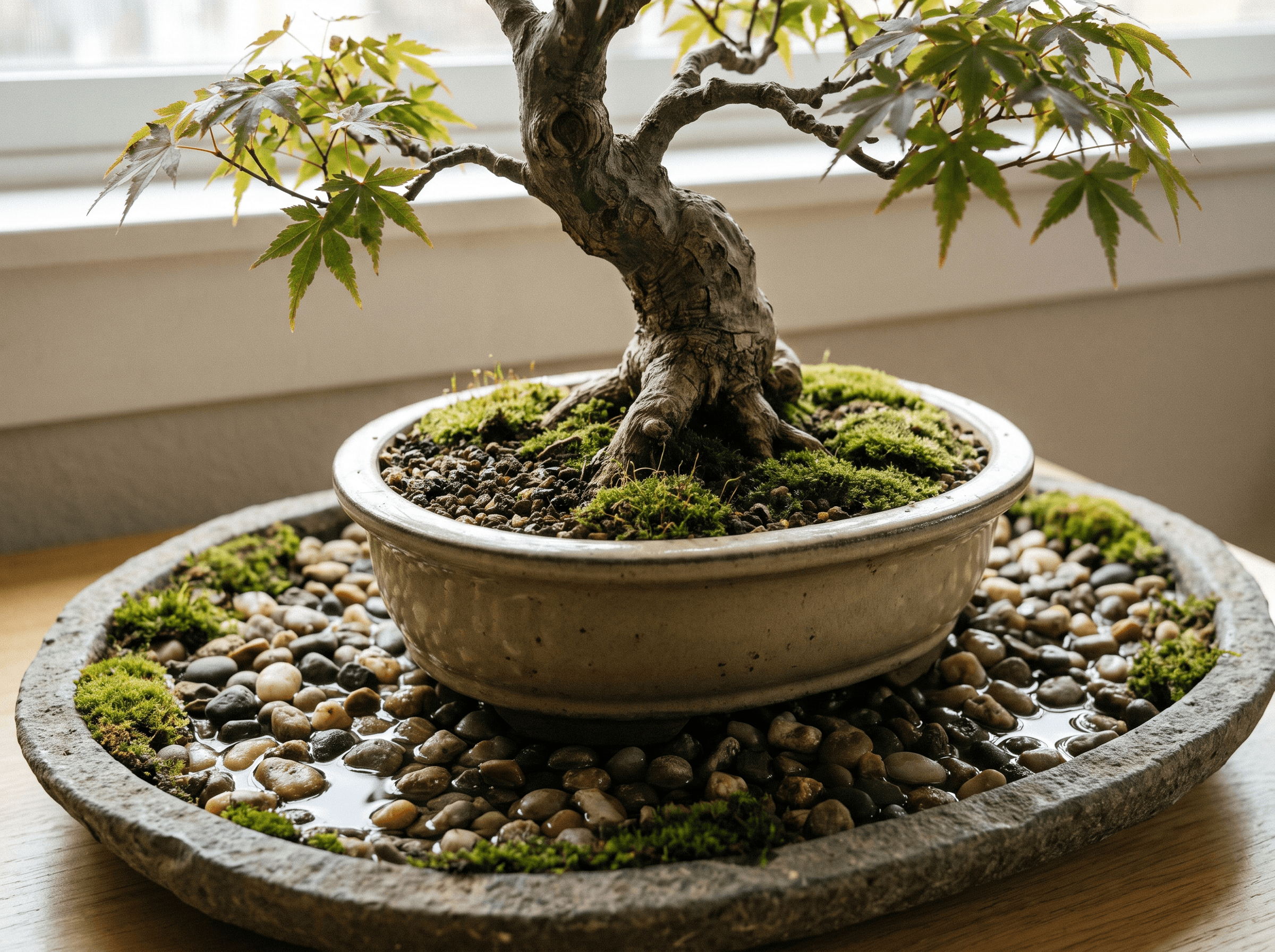
I probably see more disappointment around this topic than any other piece of bonsai equipment. Someone buys a nicely made humidity tray, sets their tree on it, goes away for ten days, and comes back to a crisp brown pine, convinced the product failed them. The product didn't fail. It was never designed to do the job they asked of it.
Bonsai substrate is the complication here. It's built to drain fast and hold air around the roots, which is exactly what makes bonsai trees healthy, but it also means the passive wicking systems that work beautifully for a houseplant in potting compost often can't keep up with a bonsai pot. Water finds the path of least resistance out of the drainage hole faster than it can be drawn back up.
So before buying anything, it's worth being clear about what each type of system actually does, because a gravel tray, a wick system, and a drip timer are three different tools solving three different lengths of problem.
Humidity trays: buffer, not backup
A basic humidity tray is a shallow dish filled with gravel or capillary matting, with the pot sitting on top and water kept below the base of the pot, not touching the roots directly. What it's intended to do is raise local humidity around the foliage; it does not water the rootball, and any effect on soil-surface drying is modest at best, mostly noticeable in dry indoor air. What it doesn't do is replace watering. I use these routinely for indoor ficus and it makes a real difference to leaf condition, but I still water the soil directly on its own schedule. Treat the tray as a comfort measure for the tree between waterings, not a substitute for them.
Wick and capillary systems: better than nothing, not fully reliable
A true wick system runs a cord or strip of absorbent material from a water reservoir up through the drainage hole into the soil, drawing moisture upward by capillary action as the soil dries. For a houseplant in dense compost this can genuinely sustain the plant for weeks. For bonsai it's a mixed bag. The fast-draining, coarse substrate we use doesn't wick water upward nearly as efficiently as potting soil does, so the top layers of the root ball can still dry out even with a working wick underneath. Results are inconsistent from one setup to the next, so I wouldn't stake a valuable tree on a wick system for any real length of absence without testing it first over a weekend while you're still home to check.
Drip timers are the dependable option
For anything approaching real dependability during an absence, a drip irrigation setup with a timer, a small pump or gravity-fed reservoir, and an individual dripper or spike at each pot, is the option I actually trust. It delivers a measured, repeated amount of water directly to the soil surface on a schedule you control, which mimics normal watering far more closely than a passive wick ever will. It costs more and takes some setup time, running tubing, positioning spikes, testing the timer, but it's the difference between hoping a system works and knowing it does, because you can watch it run before you leave.
Matching the system to the tree and the trip
A short absence, a weekend or a few days, often needs nothing more elaborate than a deep watering before you leave and a shaded spot, though how well that holds up depends on the season, the species, and how hot the weather turns out to be while you're gone. A humidity tray earns its keep every day, not just during trips, for species that appreciate higher local moisture. A wick setup is worth trying for a short absence if you test it in advance and your species tolerates some unevenness. Anything longer, or anything with trees you'd genuinely be upset to lose, points toward a drip timer, ideally backed up by someone checking in partway through.
Common questions
Do self-watering trays work for outdoor bonsai the same way as indoor ones?
The principle is the same, but outdoor conditions, wind, direct sun, low humidity, work against any passive system much harder than indoor air does. A tray that comfortably sustains an indoor ficus for a week might barely help an outdoor pine through two hot days.
Can I build a DIY wick watering system for bonsai?
Yes, a length of cotton cord or capillary matting run from a raised reservoir into the drainage hole works on the same principle as commercial versions. Test it for several days before relying on it, since how well it performs depends heavily on your specific substrate mix and pot depth.
How often does the water need topping up in a humidity tray?
Typically every few days, faster in hot or dry weather. It evaporates on its own timeline separate from how often the soil itself needs watering, so check both independently rather than assuming a full tray means the soil is fine.
Will a self-watering tray cause root rot?
Not if set up correctly, with the water level below the pot's drainage holes rather than the roots sitting in standing water. Root rot from these trays almost always comes from the water level being too high or the tray being used on a pot with poor drainage to begin with.
Which is better for bonsai, a wick system or a drip timer?
For anything longer than about a week, a drip timer is more dependable because it delivers an active, measured amount of water rather than relying on passive absorption through fast-draining substrate. Wick systems are a reasonable middle option for shorter trips.
Do all bonsai species respond the same way to these systems?
No. Species that tolerate consistently moist soil, like bald cypress, are somewhat more forgiving of a passive system than Mediterranean species like olive or juniper, which want to dry out between waterings. That said, a correctly set-up humidity tray doesn't keep the rootball wet on its own, the real risk of excess moisture comes from the water level touching the pot or the pot sitting directly in standing water, not from the tray itself.
Is it worth buying a self-watering tray if I water my bonsai myself every day?
It's still useful, mainly for the humidity boost rather than the water reserve, particularly for indoor tropical species that appreciate the extra moisture in the air around the foliage.
You might also like
General guidance based on 20+ years of practice. Every tree and every climate is different — when in doubt, ask us.