
Guy Wires and Other Bonsai Styling Aids
When a branch needs to be pulled down or into position gradually rather than bent all at once, a guy wire anchored to a sturdy point does the job that ordinary coiled wire can't.
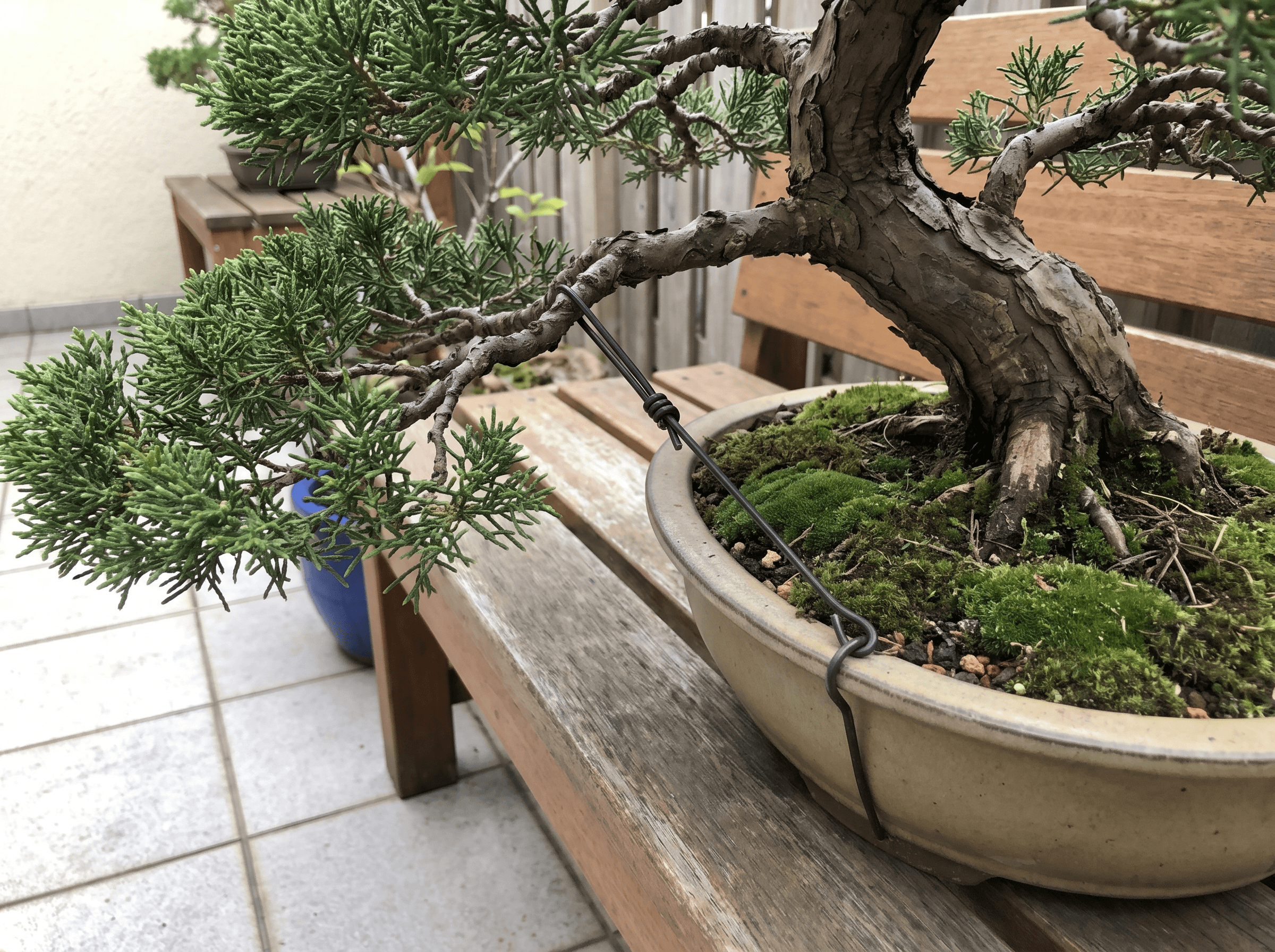
Standard wiring, coiling wire along the branch and bending it by hand, is the tool for most jobs, but not every branch cooperates with it. Some branches are too thick to bend safely in one session. Some need to move in a direction, usually straight down, that's awkward to achieve just by coiling wire around them. And some bark is thin and brittle enough that any aggressive bend risks cracking it no matter how carefully you wrap the wire first.
For those situations there's a small set of other tools growers reach for alongside standard wiring, not instead of it. Guy wires, raffia, and mechanical aids like bonsai jacks and bending clamps all work on the same basic principle: apply steady tension over time rather than force a shape in one go. They're slower methods, sometimes taking weeks or months to bring a branch into position, but that slowness is exactly what lets them handle material that regular wiring would snap.
I keep a small box of these on the bench, separate from my wire rolls, because they solve a different kind of problem than gauge and coiling technique do.
Guy wires: pulling rather than wrapping
A guy wire doesn't coil around the branch at all. Instead, one end is tied or looped around the branch and the other is anchored to something sturdy nearby, a tie-down point on the pot, a strong surface root, another branch, or even the soil near the base of the trunk are all common anchor points, and tension is applied by tightening that line. This lets you pull a branch down into a position that would be awkward or damaging to achieve by bending it directly, since the pull is gradual and distributed rather than a sudden forced angle. It's a common technique for bringing down a branch that's grown too upright, letting the tree's own flexibility and the passage of time do most of the work rather than muscle. Because the wire stays under tension right where it touches the branch for as long as it's on, check that contact point regularly and loosen or reposition the wire before it starts biting into the bark.
Raffia for protecting brittle bark
Before wiring or bending anything with delicate or brittle bark, wrapping the section in dampened raffia first gives it a layer of protection and support that spreads out the stress of bending rather than concentrating it at one point. This is common practice for aggressive bends on species prone to cracking, and for older, less flexible wood generally, where the bark and cambium underneath are more likely to split under pressure than young, supple growth. The raffia is wound snugly along the section being bent, then the wire goes on over the top as usual. It adds a step to the process but it's often the difference between a clean bend and a cracked branch on marginal material.
Mechanical bending aids for heavier material
For thick branches or trunk sections that are simply too substantial to bend by hand in one sitting, mechanical aids like bonsai jacks and dedicated bending clamps let you apply controlled, adjustable tension over an extended period, sometimes weeks, sometimes months. A bonsai jack can be tightened incrementally, a little more each session, moving the branch gradually rather than forcing the full bend at once. This is really the same principle as a guy wire, steady tension over time instead of a single forceful action, just built for material heavy enough that wire alone won't hold or move it.
These are supplements, not substitutes
None of these tools replace ordinary wiring technique, they work alongside it. A branch might get a guy wire to bring it down into rough position over a few weeks, then get coiled wire applied afterward to fine-tune the finer movements and secondary branching once it's roughly where you want it. Or a thick trunk section might be under slow tension from a jack or clamp for months while the rest of the tree is wired normally in the meantime. Thinking of these as a toolkit that gets combined as needed, rather than reaching for one method exclusively, is really the mindset shift that makes them useful.
Common questions
When should I use a guy wire instead of regular coiled wire?
Reach for a guy wire when you need to pull a branch down or into a position gradually, especially one that's grown too upright, rather than bend it directly with coiled wire. It's particularly useful when a direct bend would be awkward to achieve or risky for the branch.
What do I anchor a guy wire to?
Whatever sturdy point is available and sensibly placed for the pull you need: a tie-down point on the pot, a strong surface root, another branch, or the soil near the base of the trunk are all common choices. The anchor needs to be sturdy enough to hold steady tension over the weeks the guy wire is likely to stay in place.
Do I need to protect bark under a guy wire the same way as under coiled wire?
Yes, wherever the guy wire actually contacts the branch it can mark or damage bark just like coiled wire can, so padding that contact point, with raffia or a similar wrap, is worth doing especially on longer-term guy wire applications.
How long does raffia stay on a bent branch?
There's no fixed rule. It's providing support and protection while the bend is setting, so it's often left in place alongside the wire, but it's also fine to check it periodically and remove or refresh it if it's deteriorated before the wire itself comes off.
Are bonsai jacks and clamps only for very large bonsai?
They're most useful on thicker branches and trunk sections that are too substantial to bend safely by hand in one session, which tends to mean larger material, but the principle applies to any branch that needs slow, controlled tension rather than a single forced bend.
Can I combine a guy wire with regular wiring on the same branch?
Yes, and it's a common approach. A guy wire can bring a branch into rough position over time, and once it's roughly where you want it, standard coiled wire can be applied to shape the finer secondary growth.
Is raffia necessary for every aggressive bend?
Not every bend, but it's strongly recommended for brittle bark, older and less flexible wood, or any bend severe enough that you're genuinely worried about cracking. For younger, supple growth taking a moderate bend, it's often unnecessary.
How often should I check a guy wire once it's applied?
Check it every week or two at minimum, more often on fast-growing material. Because the wire holds constant tension against one contact point rather than distributing it along a coil, it can bite into the bark faster than you'd expect if you leave it unchecked, so loosen or reposition it at the first sign of the bark tightening around the wire.
You might also like
General guidance based on 20+ years of practice. Every tree and every climate is different — when in doubt, ask us.