
Choosing the Right Wire Gauge for Bonsai
The right gauge is simply the thinnest wire that will still hold the bend, and getting there is a matter of matching wire strength to branch thickness rather than memorizing a chart.
I still remember the first time a student handed me a branch he'd wired the night before. He'd used the thinnest roll in his kit on what was basically a small trunk, and by morning the whole thing had sprung back to where it started, wire and all, just loosely dangling off a branch that hadn't moved a millimetre. Two benches over, someone else had done the opposite: wrapped a delicate apex shoot in wire thick enough for a main trunk, and split the bark trying to force the bend. Same lesson, from two directions.
Wire gauge isn't really about a formula, even though people want one. A useful rough guide is that the wire should be roughly a third of the diameter of the branch you're bending, sometimes a little more for very stiff or brittle wood, sometimes a little less for something soft and pliable. That's a starting point, not a rule you can apply blind, because wood hardness varies a lot between species and even between the base and tip of the same branch.
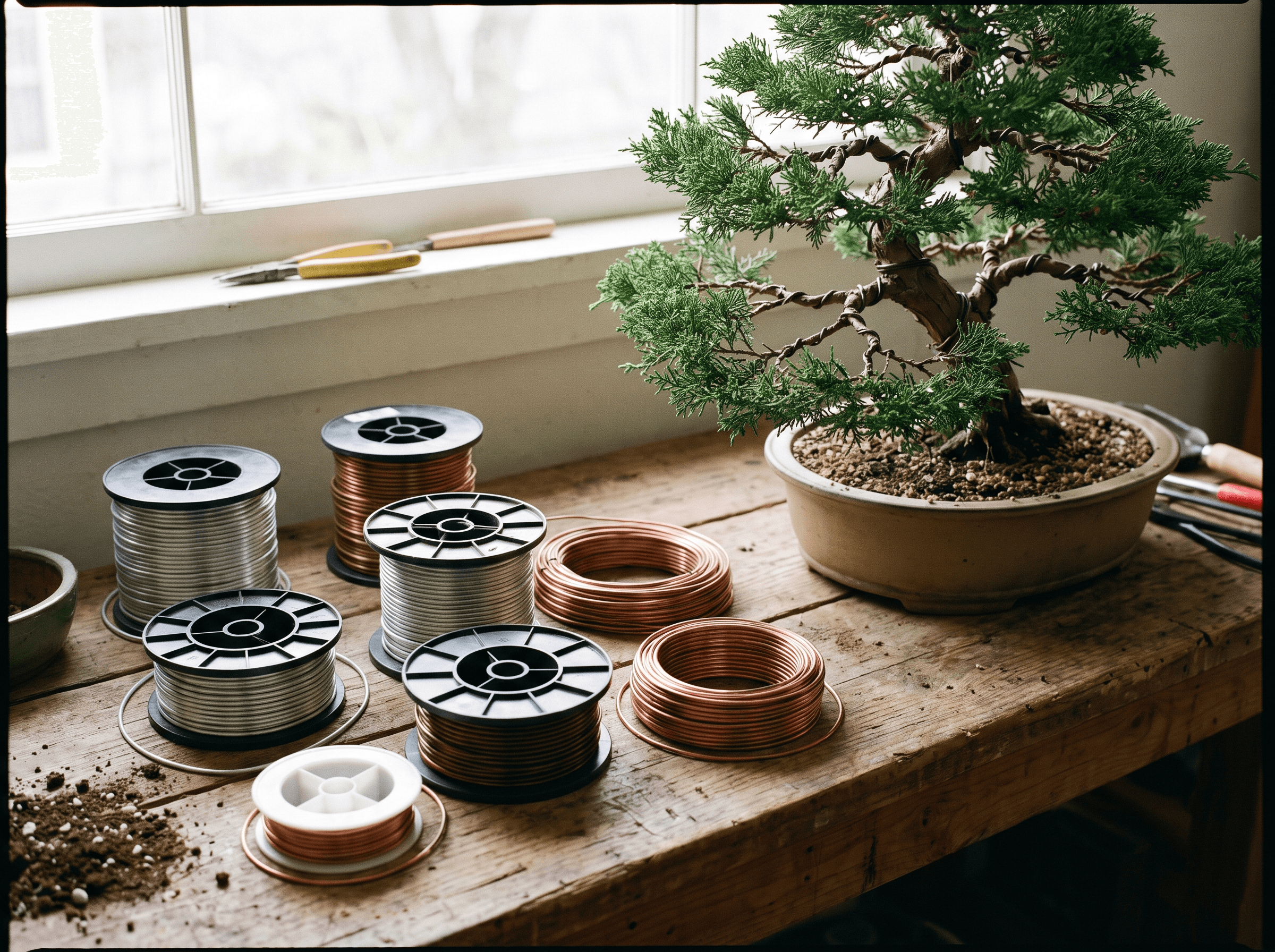
There are also two metals to choose between, aluminum and copper, and they don't behave the same way at the same thickness. Getting comfortable with gauge means understanding both the diameter ratio and which metal you're working with, since a given job might call for a different number depending on which roll you reach for.
The one-third rule, and where it breaks down
As a starting point, look at the branch you want to bend and pick a wire that's around a third of its diameter. A branch about a centimetre thick generally wants wire somewhere in the 3 to 4mm range if you're using aluminum. That ratio holds up reasonably well across most material, but it breaks down at the extremes. Very hard, dense wood, like an old juniper trunk or a hardened pine branch that's been left to lignify for years, resists bending far more than a young, sappy shoot of the same diameter, and you'll often need to go up a size or two. Soft, fresh growth on the other hand can sometimes take slightly thinner wire than the ratio suggests. The rule gets you in the right neighborhood, then your hands and eyes do the rest.
Aluminum: the forgiving choice
Aluminum wire is softer and easier to bend, which makes it the sensible starting material for anyone new to wiring, and honestly a lot of experienced growers use it for most deciduous work too. It's more forgiving of a slightly wrong gauge choice than copper, since a sizing miss is easier to correct with a rewire, and it can be unwound and reused if the coil comes off clean. The tradeoff is that for a given thickness it holds a bend with less force than copper, so when you're deciding between two sizes for aluminum, I'd usually tell a beginner to size up rather than down. A slightly thicker aluminum wire that's a bit more work to apply beats a thinner one that lets the branch creep back over the following weeks or months.
Copper: more holding power, more commitment
Copper wire is stronger than aluminum at the same diameter, which means you can often use a noticeably thinner gauge of copper to achieve the same holding power, and thinner wire is less visually obtrusive on a finished tree. That's part of why copper is the traditional choice for refined conifer work, pines and junipers especially, where growers care a great deal about how the wire looks against the bark while it's on. The catch is that bonsai copper is sold pre-annealed, heated and cooled at the factory to soften it enough to apply, and it still takes noticeably more hand strength to work than aluminum. Once it's on and hardens back up under tension, it's generally not worth trying to reuse the way aluminum sometimes is. It's also simply harder to work with for anyone still building the muscle memory for wiring, so I don't hand it to complete beginners very often.
What goes wrong when the gauge is off
Wire that's too thin for the job won't hold the branch in its new position. You'll do the bend, it'll look right, and over time, sometimes within weeks but often longer, the branch will slowly relax back toward its original line, sometimes carrying the loose wire with it. Wire that's too thick is a different kind of problem. It's genuinely hard to wrap cleanly around the branch, it takes a lot of force to apply, and that force is exactly what can crack bark or snap a branch that isn't ready for it, particularly on brittle species. I've seen more damage done by growers fighting oversized wire than by wire that was slightly too thin and just needed a second pass.
One tree, several gauges
A single wiring session on a mature tree rarely uses just one gauge. The trunk or a thick primary branch might need a heavier wire, while the same branch's secondary growth further out, and the fine twigs at the very tips, need progressively thinner wire as the wood gets thinner. I generally keep four or five gauges of aluminum on the bench when I sit down to wire a tree, moving to a thinner roll each time I work my way further from the trunk. A useful starter spread is something like 1mm, 1.5mm, 2.5mm, and 4mm, which between them cover most of what you'll meet on a small to medium tree. It's worth building a small collection of sizes rather than trying to make one or two gauges do every job on the tree, which is usually how you end up with either loose wire on the fine growth or crushed bark on the heavier limbs.
Common questions
What gauge wire do I need for a pencil-thick branch?
A branch around pencil thickness, roughly 7 to 8mm, usually takes aluminum wire in the 2.5 to 3mm range, following the rough one-third ratio. If the wood is unusually stiff or you're working with copper instead, you can generally go a size thinner.
Is copper wire really stronger than aluminum at the same thickness?
Yes, copper holds a bend with more force than aluminum of the same diameter, which is why growers can often use a thinner gauge of copper to do the same job as a thicker gauge of aluminum. That extra strength is also what makes copper harder to apply by hand.
Should beginners start with aluminum or copper wire?
Aluminum, almost without exception. It's softer, more forgiving of a wrong gauge choice, and can be reused if you unwind it cleanly. Copper takes more hand strength and more experience to apply well, and mistakes are less easily undone.
Can I reuse bonsai wire after removing it?
Aluminum wire can often be reused if it comes off in one clean piece without kinks, though most growers cut wire off in short segments rather than unwinding it, which usually rules out reuse anyway. Copper wire, once it has hardened under tension, generally isn't worth trying to reuse.
What happens if I use wire that's too thick?
Oversized wire is difficult to wrap tightly and evenly, and forcing a bend with it risks cracking bark or snapping the branch, especially on brittle or thin-barked species. If a gauge feels like a struggle to apply, it's usually too thick for that branch.
Do I need a different wire gauge for every tree species?
Not species specifically, but wood hardness does vary between species and that affects gauge choice. A stiff, dense-wooded conifer often needs a heavier gauge than a soft-wooded deciduous branch of the same diameter, so it pays to test the bend on a small section before committing to a whole branch.
How many different gauges should I keep on hand?
Most growers end up with four to six gauges of aluminum in regular rotation, covering everything from thick primary branches down to fine twig growth at the tips. You don't need every size on the market, just a reasonable spread so you're not forcing one gauge to do jobs it wasn't sized for.
You might also like
General guidance based on 20+ years of practice. Every tree and every climate is different — when in doubt, ask us.