
Kiyohime Maple Bonsai
Acer palmatum 'Kiyohime'
Kiyohime is a dwarf Japanese maple cultivar grown for small leaves and very short internodes, meaning new growth stays compact and close together instead of stretching out the way a standard Japanese maple does. That habit makes it one of the better maples I recommend for shohin and other small sizes, and for anyone chasing fine, detailed ramification without spending years fighting the tree's natural tendency to throw long, leggy shoots.
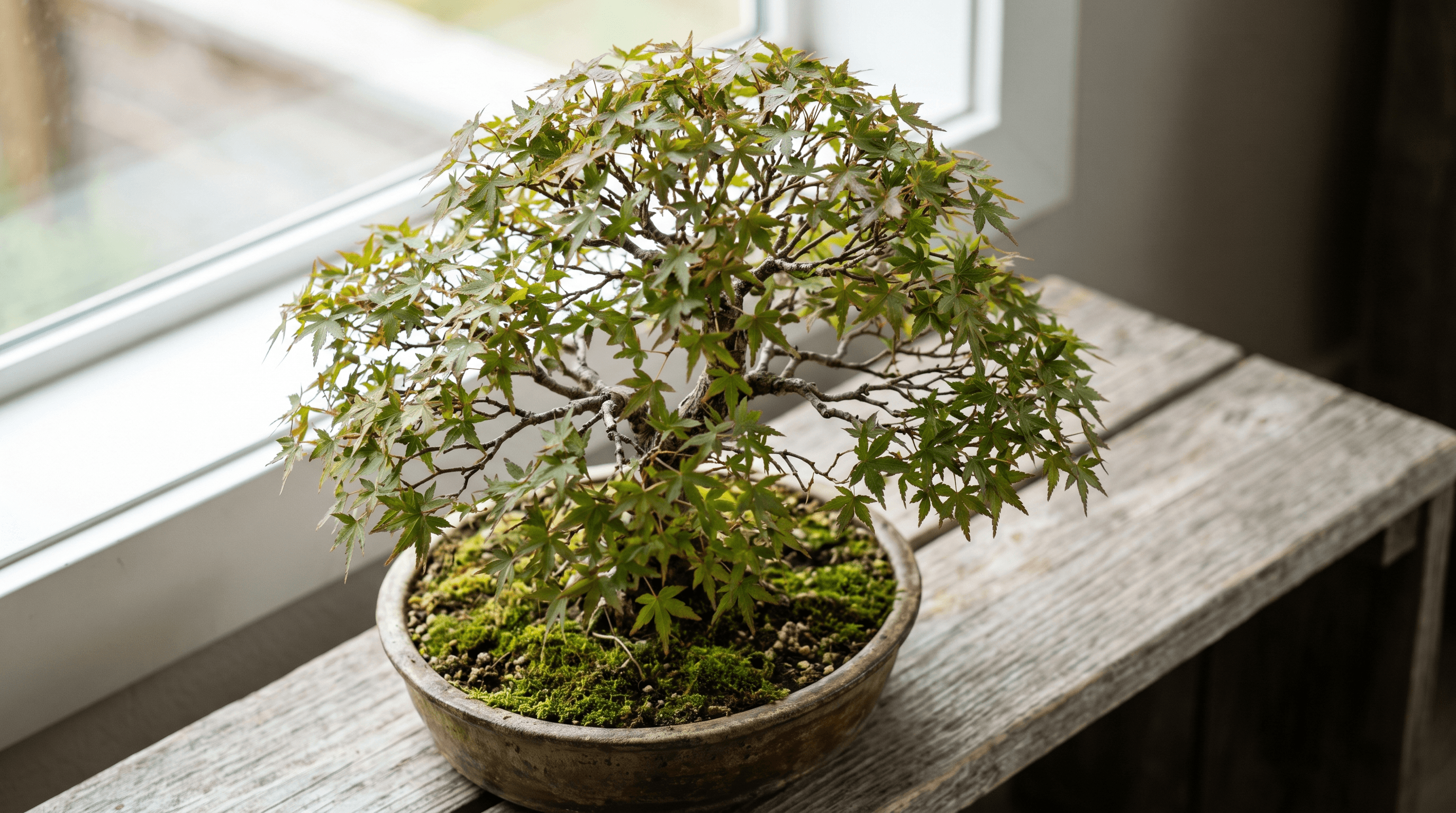
Acer palmatum 'Kiyohime' is a Japanese maple cultivar selected for compact, dwarf growth rather than for a particular colour display. The leaves are noticeably smaller than a standard Japanese maple's, and the internodes, the gaps between leaf nodes along a shoot, are naturally short, so the tree builds a dense twiggy structure with less coaxing than most maples need. Underneath that habit it's still ordinary Acer palmatum in terms of basic needs: real winter dormancy, careful sun placement, and consistent moisture, so most of what applies to Japanese maple generally applies here too.
Where Kiyohime earns its reputation is scale. Because the leaves stay small and growth is naturally tight, it suits smaller pots and finer proportions than the species typically allows, which is exactly why it turns up so often in shohin and mame-size collections. It's not the only dwarf-habit cultivar out there, Kotohime and Mikawa Yatsubusa cover similar ground with their own particular leaf shape and growth character, but Kiyohime is a reliable, relatively vigorous choice among the compact cultivars, which makes it a bit more forgiving to develop than some of the very slowest-growing dwarf forms.
Care
Light
Light needs follow standard Japanese maple: morning sun with protection from harsh afternoon sun once summer heat sets in, since the leaves, being smaller than the species norm, can scorch under strong, direct afternoon light in hot weather much the way any maple's would. Kiyohime doesn't need unusually strong light to perform, since it isn't grown for a spring colour display the way some other cultivars are; the goal here is steady, healthy growth that keeps internodes short, and that comes from good general light and vigor rather than any particular sun intensity.
Watering
Keep the soil evenly moist through the growing season, the same as any Japanese maple, since the fine root system doesn't tolerate the soil drying out fully. Because Kiyohime is so often grown in smaller pots to suit its compact habit, and small pots dry out faster than larger ones, watering frequency in practice tends to run higher than for a standard-sized Japanese maple in a bigger container, simply as a function of pot size rather than anything about the cultivar's water needs being different. Check daily through the growing season and expect more than once a day in hot weather once the tree is in a genuinely small shohin pot.
Temperature & hardiness
Kiyohime needs the same genuine outdoor winter dormancy as Japanese maple generally and is reasonably cold-hardy as a tree, but the practical risk with any small-potted maple, Kiyohime included, is that a shallow, small container offers roots less insulation than a larger pot would, so protecting the pot itself during severe hard freezes matters more here than it might for a maple in a bigger container. Late frost after the spring flush is the same seasonal concern as with the species generally, since new growth is tender regardless of how small the leaves eventually get.
Soil & potting
A free-draining but moisture-retentive mix, the same akadama-based approach that suits Japanese maple generally, works well for Kiyohime too. Pot choice is really the distinguishing factor: because the cultivar's small leaves and short internodes read well at small scale, it's commonly grown in shallow, compact shohin or mame pots rather than the larger containers a standard Japanese maple might sit in, and a smaller soil volume means less buffer against drying out or overwatering, so the margin for error on watering timing is narrower than in a bigger pot.
Fertilizing
Feed through the growing season on the same schedule as Japanese maple generally, easing off as autumn approaches. Because a small-pot, dwarf-habit tree has a smaller root volume to draw on, I'd lean toward light, frequent feeding over occasional heavy doses even more than I would with a standard-size maple, since the margin for a fertilizer mistake, either burning fine roots or overfeeding into leggier growth than you want, is tighter in a small container. Pushing too much nitrogen can also encourage larger leaves and longer internodes than the cultivar naturally wants to produce, working against the compact character that's the whole reason to grow it.
Pruning & wiring
Ramification building on an established, already-refined Kiyohime follows the usual Japanese maple method, pinching and trimming new shoots back to a leaf pair repeatedly through the growing season. Younger or weaker trees are better left to extend and harden before cutting back, since pinching too early or too often can weaken a tree that hasn't built up enough strength yet. On a refined tree, Kiyohime's naturally short internodes mean you get a denser result from the same effort compared to a standard maple, since it isn't fighting you by throwing long shoots between leaf pairs. This is a large part of why the cultivar suits fine ramification work so well once established. Wiring benefits from finer-gauge wire than you'd typically reach for on a larger maple, since the branches themselves stay proportionally thinner at this scale, and Kiyohime's bark is no less prone to scarring than the species generally, so check wire often on young growth. Heavier structural cuts are best kept away from the high-sap-flow period around bud swell in late winter into early spring; beyond that, growers vary between summer or early autumn work and pruning later in dormancy, so avoiding the bud-swell window matters more than picking one fixed season.
Repotting
Repot based on root condition rather than a fixed calendar: young or very small-pot trees often need attention every one to two years, while established trees usually go longer between repots, based on root density and drainage. A small shohin pot with limited soil volume can sometimes need attention sooner if you notice vigor dropping off or roots filling the container faster than expected. Handle the fine root system gently at repotting, combing rather than raking hard, and be aware that root work in a genuinely small pot leaves less margin than the same work would on a tree in a larger container, so it's worth being a bit more conservative with how much you remove at once until you know how a particular tree responds.
Common problems
The issues that come up with Kiyohime are largely the standard Japanese maple set: scorched leaf edges from too much direct afternoon sun, leaf drop or wilting from either underwatering or waterlogged roots, aphids on new spring shoots, and blackened new growth from late frost after budbreak. The cultivar-specific pattern I'd flag is growth that starts pushing longer internodes and larger leaves than expected, drifting away from the compact character that's the reason to grow Kiyohime in the first place; that's usually a sign of too much shade, too much nitrogen, or shoots that have simply been allowed to run without being cut back, rather than anything wrong with the tree's health. It's rarely a sign the pot has become too small, a restricted root system tends to suppress vigor rather than push larger leaves and longer growth. Because it's so often grown in small pots, drying out is also a more frequent practical problem here than with maple generally, simply due to the smaller soil volume having less buffer.
Styling
Kiyohime is a natural fit for shohin and mame-scale bonsai specifically because the small leaf size and tight internodes let a tree read as fully mature and well-ramified at a scale where a standard Japanese maple's proportionally larger leaves would look out of place. Informal upright and broom styles both work well, the same forms that suit Japanese maple generally, but here the emphasis leans even more toward achieving fine, dense branch structure since that's the trait the cultivar is chosen for. Compared to other dwarf and small-leaf Japanese maple cultivars, Kiyohime is vigorous for a dwarf, and Mikawa Yatsubusa in particular is notably slower-growing; growth rate relative to Kotohime can vary with material and growing conditions, so I wouldn't rank the two reliably against each other. Where Kiyohime does run more vigorous, that makes it somewhat more forgiving to develop from younger material, though the trade-off is that it takes slightly more discipline with pruning and feeding to keep growth as tight as the slowest dwarf forms manage on their own.
Common questions
What makes Kiyohime different from a regular Japanese maple?
Mainly leaf size and internode length. Kiyohime has noticeably smaller leaves and much shorter gaps between leaf nodes than a standard Japanese maple, which gives it a naturally dense, compact growth habit. Basic care, light, water, soil, hardiness, is essentially the same as Japanese maple generally.
Is Kiyohime good for shohin bonsai?
Yes, it's one of the more commonly recommended maples for shohin and mame sizes specifically because the small leaves and short internodes let it look proportionate and well-ramified at small scale, where a standard Japanese maple's larger leaves would look oversized.
Why is my Kiyohime's growth getting leggier and its leaves larger over time?
That usually points to too much shade, too much nitrogen, or shoots that have been allowed to extend too long without being cut back. All three can push the tree away from the compact character the cultivar is chosen for. It's rarely about the pot being too small, a restricted root system tends to suppress vigor rather than cause it. Checking light levels, feeding regime, and how consistently shoots are being trimmed back is the right place to start.
Does Kiyohime need a smaller pot than other Japanese maples?
It's commonly grown in smaller pots because its scale suits that, but it doesn't strictly require one. A smaller pot does mean less soil volume and faster drying, so watering needs more attention than with a maple in a larger container.
How does Kiyohime compare to Kotohime or Mikawa Yatsubusa?
All three are compact, small-leaved Japanese maple cultivars. Kiyohime is vigorous for a dwarf, and Mikawa Yatsubusa is notably slower-growing, but growth rate relative to Kotohime can vary with material and growing conditions, so I wouldn't rank Kiyohime reliably above both. Where it does run more vigorous, it's a bit easier to develop from younger material, at the cost of needing more consistent pruning discipline to keep the growth as tight as the slower dwarf forms manage naturally.
Does Kiyohime still get autumn colour?
Yes, it colours in autumn the same way Japanese maple generally does, though the display reads differently at small leaf scale than on a standard-size maple. It isn't selected for a spring colour flush the way cultivars like Deshojo are; its main trait is the compact growth habit, not foliage colour.
General guidance based on 20+ years of practice. Every tree and every climate is different — when in doubt, ask us.