
Shishigashira Maple Bonsai
Acer palmatum 'Shishigashira'
Shishigashira, the lion's head maple, is grown for a leaf that doesn't behave like a normal Japanese maple leaf at all, tightly curled and crinkled with short internodes and a naturally dense, slow-growing habit, and that unusual texture changes how you approach pruning and styling more than it changes basic day-to-day care.
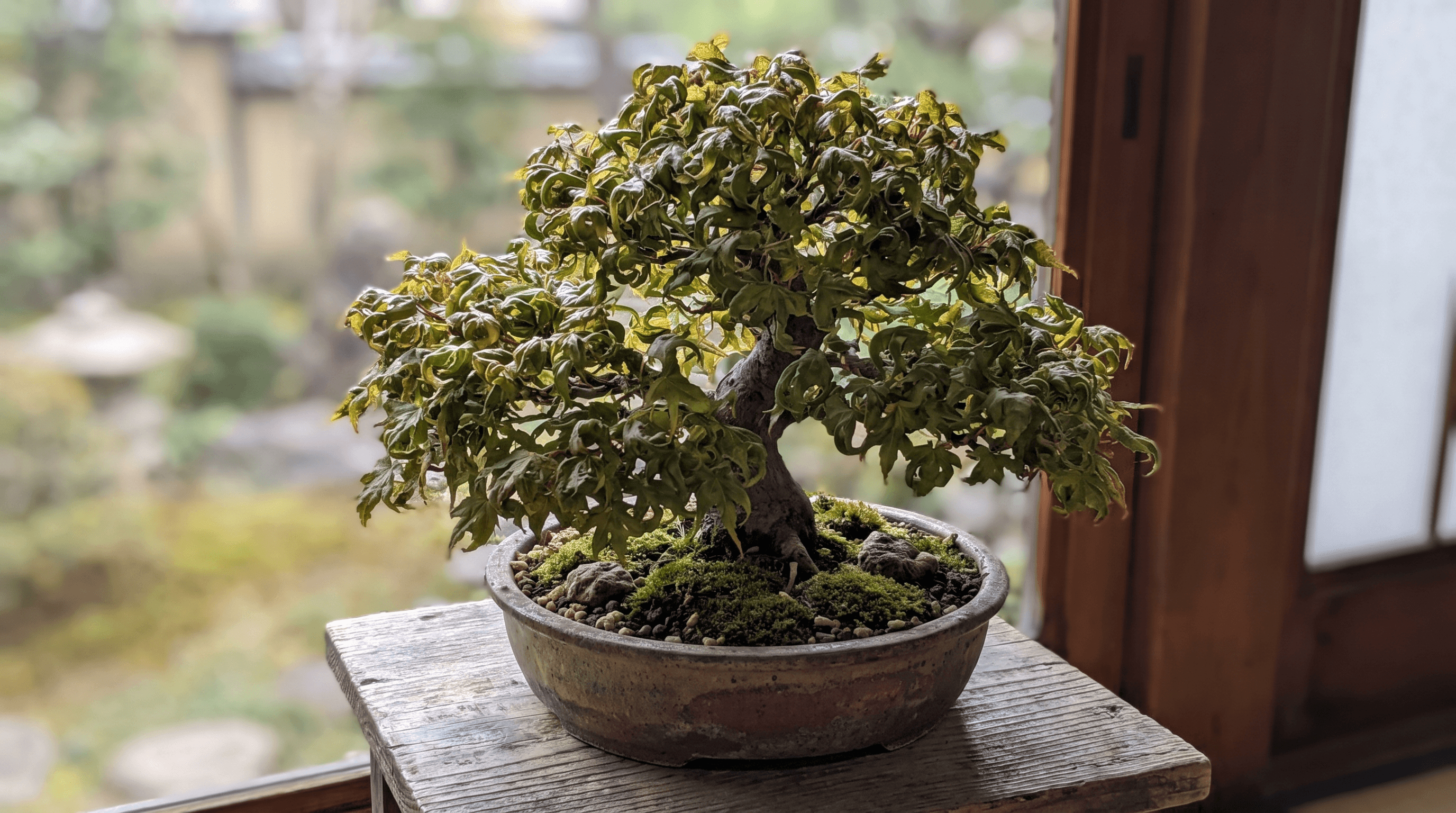
'Shishigashira' is an old cultivar, named for a resemblance between its bunched, curled foliage and the shaggy mane of a lion's head ornament used in Japanese festival costumes. Where a typical Japanese maple leaf lies flat with a clean, open five- or seven-lobed shape, Shishigashira's leaves are smaller, thicker, and crinkled, clustered tightly along short internodes rather than spread out along longer shoots. The overall effect at bonsai scale is a dense, textured canopy that looks packed and mature even on a relatively young tree, which is a large part of the cultivar's appeal.
The growth habit that produces that texture also makes this one of the slower-growing Japanese maple cultivars I work with. Shoots extend less per season than on a regular maple, and the tree naturally wants to stay compact and twiggy rather than throwing long extension growth that needs constant cutting back. That's mostly good news for anyone building a formal, tightly clipped canopy, since the tree is doing a lot of the density work on its own, but it does mean patience is part of the deal, and a young Shishigashira takes longer to bulk up trunk and branch thickness than a vigorous seedling-grown maple would. Below the surface, though, it's still Acer palmatum, with the same need for outdoor winter dormancy and the same sensitivity in bark and fine roots as the species generally.
Care
Light
Morning sun with protection from harsh afternoon sun suits Shishigashira the same way it suits Japanese maple generally. The tight, curled leaf shape doesn't change light needs much, though I've found the thicker, more crinkled foliage seems a touch less prone to obvious scorch marks than the thin, flat leaf of a standard maple, without being genuinely sun-tolerant, so I'd still treat it with the same caution rather than assume it can take harsher exposure. Good bright light without deep shade keeps the naturally dense canopy from thinning out further.
Watering
Keep the soil evenly moist through the growing season, the same standard as any Japanese maple, since Shishigashira's fine root system isn't any more drought-tolerant than the species type despite the tougher-looking foliage. Because the tree is often grown in a smaller pot to suit its compact habit, don't assume slower top growth means slower water use; check the soil directly rather than judging by how much the canopy seems to be doing.
Temperature & hardiness
Shishigashira needs the same real outdoor winter dormancy as any Japanese maple, and shouldn't be brought indoors through winter. It's reasonably cold-hardy as a species, with the usual caveat that a shallow bonsai pot exposes roots to cold more than open ground does, so protect the container itself during severe, prolonged freezes. Shishigashira actually tends to leaf out early in spring, which makes it more exposed to late-frost damage than a slower-emerging maple, not less, so watch the forecast closely through early spring and be ready to protect fresh growth if a late cold snap is coming, the same caution as with any maple but with less margin for error.
Soil & potting
A free-draining but moisture-retentive mix, akadama-based blends with some pumice being a common and reliable choice, works the same for Shishigashira as for Japanese maple generally. Because this cultivar is so often grown small, in shohin or even smaller sizes given how naturally compact and dense it stays, pot proportions and mix particle size are usually scaled down accordingly, and a mix that drains well in a larger pot can behave quite differently in a shallow, small one, so keep an eye on how quickly a small container actually dries in your conditions rather than assuming the same mix behaves identically at every scale.
Fertilizing
Feed through the growing season on the same general timing as Japanese maple, after spring leaves have hardened off through to late summer, then tapering off. Given how slowly Shishigashira grows compared to a standard maple, I lean toward lighter, more frequent feeding rather than trying to push growth with heavier doses, since forcing rapid extension growth works against the naturally tight, compact character that's the whole reason for growing this cultivar in the first place. A balanced feed through the growing season is generally enough; there's little upside to heavy feeding aimed at speeding up a tree whose appeal is precisely that it doesn't grow like a typical maple.
Pruning & wiring
This is where Shishigashira really departs from ordinary Japanese maple technique. Because the leaves cluster tightly on short internodes rather than extending along longer shoots, the usual pinch-to-a-leaf-pair approach used to build ramification on a standard maple has less to work with here; growth is already dense by nature, and pruning is more about maintaining and refining an existing tight structure than building one from scratch through repeated pinching. Many growers lean toward a more formal, tightly clipped silhouette with this cultivar for exactly that reason, since the naturally bunched foliage reads well in that kind of controlled, clipped canopy. As with maple generally, avoid heavy structural cuts in late winter when sap bleeding is worst, favouring summer or early autumn instead. Wiring is usually needed less than on a standard maple given the short internodes and naturally compact habit, but where it is used, check it often since bark still marks easily and the slower growth rate means a branch can hold wire scars for a long time before new growth disguises them.
Repotting
Repot on a similar early-spring timing to Japanese maple generally. Every two to three years is a reasonable starting point even on a younger tree, but let the actual trigger be root density in the pot, how well the mix is still draining, and how far the substrate has broken down, rather than assuming this cultivar's growth rate sets the interval on its own. Handle the fine root system gently at repotting, and give the tree the same couple of sheltered weeks afterward, out of strong wind and harsh sun, that any freshly repotted maple needs while new roots establish.
Common problems
Slow, seemingly stalled growth is the complaint I hear most with Shishigashira, and it's usually not actually a problem at all, just the cultivar's naturally unhurried pace being mistaken for weakness; check for other signs of stress, like poor leaf colour or dieback, before assuming something is wrong and reaching for heavier feeding as a fix. Thin, sparse patches in the canopy can result from insufficient light, interior congestion, root stress or previous dieback, so it's worth checking growing conditions broadly rather than pinning it on any single cause. Leaf scorch shows up the same as on standard Japanese maple, as browned, crispy edges after too much harsh direct sun, though I find it slightly less dramatic-looking on this cultivar's thicker, more crinkled leaf. Aphids and general pest pressure track the same as on Japanese maple broadly, worth checking on new growth as it emerges even though that emergence is slower and less obvious than on a vigorous seedling maple. Dieback on one side of an otherwise healthy tree should be checked for the same soil-borne issues that affect maples generally rather than assumed to be a quirk of the cultivar.
Styling
Shishigashira's naturally dense, short-jointed growth makes it a strong candidate for formal upright and other tightly clipped, controlled styles, since the tree essentially wants to grow into a compact, textured canopy on its own rather than needing years of pinching to build that density the way an open-growing maple cultivar does. Because trunk and branch thickening happen slowly, it's also a cultivar where starting with reasonably developed material, or accepting a longer development timeline on a young one, makes more sense than expecting rapid change year to year. The distinctive curled, clustered foliage reads as texture from a distance rather than as individual leaf shape, which suits shohin work particularly well. The leaves themselves are usually in the 3 to 5 cm range rather than truly minute, so for the very smallest mame sizes a cultivar like Kotohime is the stronger choice on leaf size alone, but Shishigashira's dense, mature-looking canopy can still make a small tree look older and more finished than its actual age.
Common questions
Why is my Shishigashira maple growing so slowly?
That's normal for this cultivar rather than a sign of a problem. Shishigashira is naturally one of the slower-growing Japanese maple cultivars, with short internodes and a compact habit by design. Check for other stress signs like poor colour or dieback before assuming the slow pace itself is an issue.
Do I need to pinch Shishigashira the same way as a regular Japanese maple?
Standard maple pinching often needs adapting here rather than dropped altogether. Its extremely short internodes mean the usual pinch-to-a-leaf-pair approach can leave nodes too tight, so pruning is more about maintaining and refining the existing dense structure, sometimes deliberately allowing a bit more extension than you would on a standard maple, rather than building ramification from scratch through repeated pinching.
Why does Shishigashira's leaf look different from other Japanese maples?
It's a selected cultivar with tightly curled, crinkled foliage rather than the flat, open lobed leaf typical of Acer palmatum, clustered on short internodes. The name refers to a resemblance to a lion's head festival ornament. It's a foliage-texture trait bred into this particular cultivar.
Is Shishigashira good for small bonsai sizes?
Yes, it's a popular choice for shohin and smaller sizes because the naturally dense, compact growth gives a mature, textured look without needing years of ramification work first. Just be patient with trunk and branch thickening, which happens slowly on this cultivar.
Does Shishigashira need different watering or soil than a normal Japanese maple?
No, the baseline needs are the same as Japanese maple generally, consistent moisture without waterlogging in a free-draining but moisture-retentive mix. Slower top growth doesn't mean the roots use less water, so don't ease off watering just because the canopy looks unhurried.
Is Shishigashira a good beginner bonsai?
It suits a patient beginner reasonably well, since the naturally dense habit forgives some inexperience with pruning technique compared to a fast-growing maple that needs constant pinching. The trade-off is slow visible progress, which can be discouraging if you're expecting quick change.
General guidance based on 20+ years of practice. Every tree and every climate is different — when in doubt, ask us.