
Japanese Red Pine Bonsai
Pinus densiflora
Japanese red pine bonsai (Pinus densiflora) uses the same two-flush decandling technique as black pine, but the tree underneath it is a different animal: softer branches, thinner bark, and a more slender, elegant overall character that rewards a gentler hand than most growers bring to black pine.
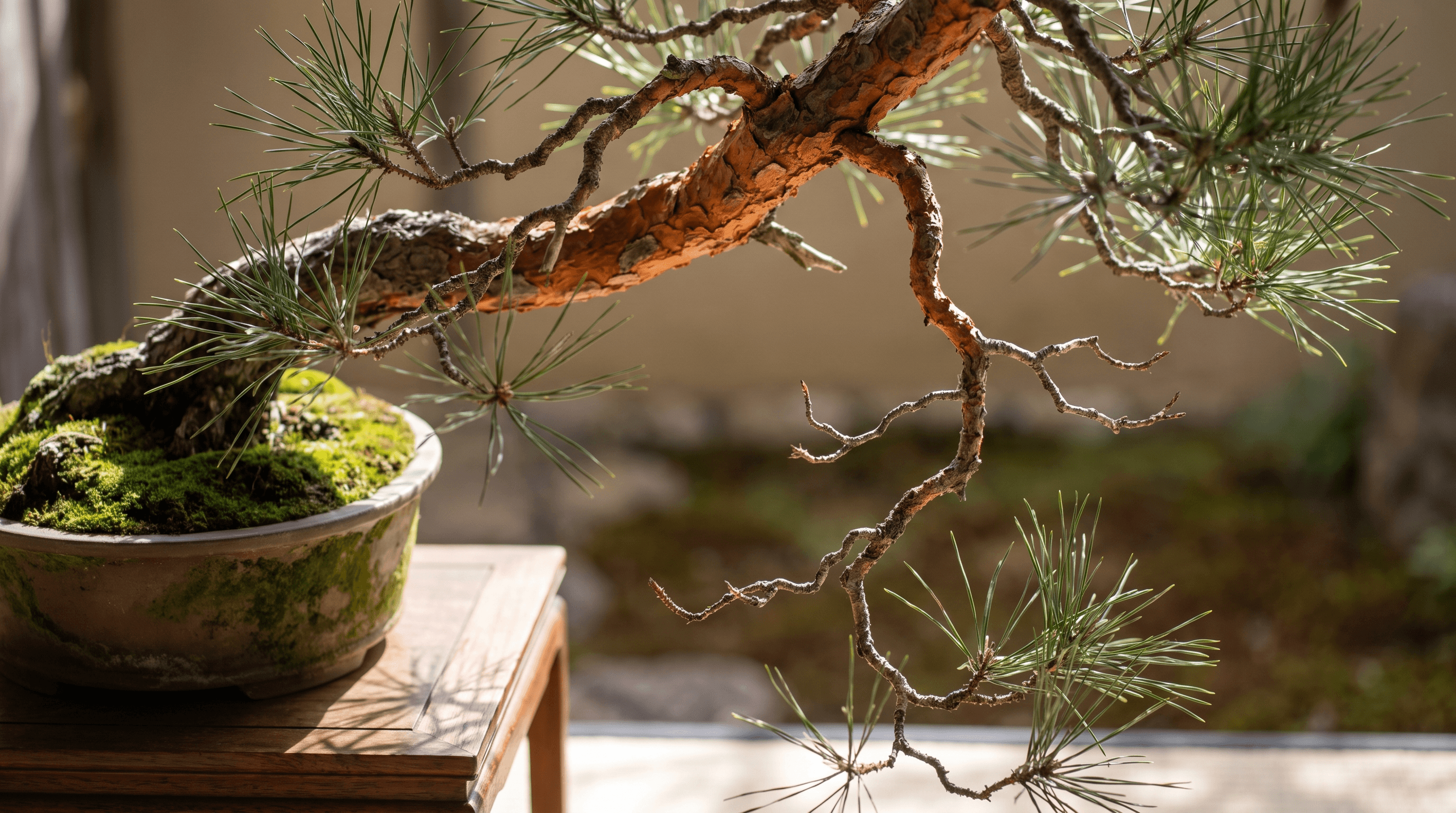
Red pine sits alongside black pine as one of the two great classical Japanese bonsai pines, and traditionally growers have paired them as a kind of masculine and feminine contrast: black pine for power, red pine for grace. I think that framing holds up reasonably well once you've grown both. Red pine's needles are generally softer and finer than black pine's, the branches are thinner and more willowy, and the bark stays smoother for longer before it starts breaking up, with a reddish-orange color developing on the upper trunk and branches that's one of the tree's best features once it's had time to mature. It's a tree that reads as refined rather than rugged, and the styling decisions that suit it tend to follow from that.
Technically, red pine is decandled the same way black pine is: it's a two-flush species in a suitable climate, so cutting back the elongating candles in early summer forces a second, more compact flush with shorter internodes and finer needles, and that's the backbone of building refined pads on this tree just as it is on black pine. A healthy, well-refined red pine can be fully decandled just like a strong black pine, so this isn't a case of a fundamentally different technique. Where I'd push back a little on treating them as identical is restraint. Red pine's more delicate branch structure and generally lower overall vigor compared to black pine mean I leave weak shoots alone rather than decandling them along with the strong ones, skip the whole procedure on a tree that's been recently repotted or stressed and hasn't shown a full recovery, and retain more foliage on the tree when I thin needles later in the season. I'd encourage you to read your specific tree's vigor rather than assume every red pine needs the lighter touch, a strong, established tree often doesn't.
Care
Light
Full sun is preferred, and that should be the default rather than the exception. In exceptionally hot climates, the better response to summer stress is to protect the rootball from excessive heat and keep a closer eye on watering, rather than routinely shading the foliage, since red pine still wants as much light as it can get to keep needles short, internodes tight, and back-budding reliable. Reduced light on this species shows up as the same thing you'd see on any pine: longer, weaker internodes and thinner, paler foliage, which works directly against the fine, dense character red pine is prized for.
Watering
Let the soil surface dry a little before watering thoroughly again, and treat good drainage as non-negotiable. Red pine's roots are, if anything, a bit less forgiving of staying wet than black pine's, in keeping with the overall more delicate character of the tree, so I'd rather err toward slightly drier than risk soggy soil. Signs of overwatering build slowly here too, as a gradual dulling and yellowing of needles over weeks rather than sudden collapse, which makes it easy to keep making the same mistake without noticing the cause until the tree has lost real vigor.
Temperature & hardiness
Red pine is a reasonably adaptable, cold-hardy tree in its native range across Japan, Korea, and parts of China, and it grows well in a range of temperate climates. It doesn't have quite the heat tolerance reputation that Japanese black pine has built up as a Mediterranean bonsai subject; in exceptionally hot climates I focus on protecting the rootball and watching water closely rather than shading the tree, since it still wants strong light for tight, compact growth. Outdoors year-round, with the pot protected from hard freezes, is the right approach; like other pines it has no business coming indoors.
Soil & potting
A fast-draining, mineral mix is essential, the same baseline you'd use for black pine: akadama, pumice, and lava rock in roughly equal parts works well as a starting point. Given red pine's somewhat lower tolerance for wet roots, I don't mind leaning the mix a little more toward pumice and lava on this species specifically. Red pine also forms beneficial mycorrhizal relationships in the soil, so carrying some of the old mix forward at each repot rather than starting completely sterile helps that fungal community establish itself again more quickly.
Fertilizing
Red pine feeds well through a full season from spring into early autumn, tapering off as growth slows, broadly in line with other pines. Because decandling depends on the tree going into it strong, feeding around that window matters more than following one exact schedule; some growers feed heavily through spring and hold off resuming until well after the second flush has hardened, others ease off for a shorter stretch right around the cut and pick feeding back up sooner. What matters more than the specific calendar is that the tree is genuinely vigorous and well fed heading into decandling, and that you don't rush fertilizer back onto a tree that's still recovering. I keep the overall feeding a touch more moderate on red pine given its generally lower vigor than black pine, rather than pushing it as hard as I might a strong black pine, but I wouldn't treat any single ease-off-and-resume schedule as a fixed rule.
Pruning & wiring
Red pine is decandled the same way black pine is, in early summer, cutting back the newly elongated candles on an established, vigorous tree to force a shorter, more refined second flush with tighter internodes and finer needles. That basic mechanism is identical between the two species, and a strong, well-refined red pine can be fully decandled just like a strong black pine. What changes is the margin for error. Black pine tolerates a fairly aggressive, whole-tree decandling schedule most years once it's established; red pine, with its more delicate branch structure and generally softer overall vigor, gives you less room to push a weak branch or a recently stressed tree through the same treatment, and I've seen weaker red pines lose branches after being decandled as hard as a strong black pine would tolerate. My practice is to leave weak shoots alone rather than decandling them along with the strong ones, and to skip the whole tree entirely if it's shown any stress since the last repot or a hard winter, but on a genuinely healthy, established tree I'll decandle the whole thing the same as I would a black pine. In autumn, thin and pluck older needles by hand to keep light reaching the inner canopy, which matters even more on red pine given how easily its finer branches get shaded out and die back; I also tend to leave more needles per shoot on red pine than I would on black pine during this thinning, since the tree's lighter overall vigor and finer branch structure don't carry the same bare, exposed look as well. Wiring suits red pine's slender branches nicely since they take movement readily, but that same slenderness means they're also easier to damage, so I use thinner wire and check it more often than I would on a stout black pine branch.
Repotting
Red pine is generally repotted on a similar cycle to black pine, often every three to five years for an established tree, though I'd lean toward the more conservative end of that range given the species' somewhat lower overall vigor. Early spring, as the buds start to swell, is the right window. Root work should be measured rather than aggressive: work the outer portion of the root mass, avoid heavy bare-rooting, and get the tree back into a fast-draining mix quickly. Give a freshly repotted red pine a couple of weeks of shelter from harsh sun and wind, and I'd watch it a little more closely than I would a black pine during that recovery period.
Common problems
Yellowing needles are the most common complaint, usually traced back to overly wet soil, root disturbance from a recent repot, or insufficient light. Because red pine runs a bit less vigorous than black pine overall, I'd also flag general dieback on weaker branches as something to watch for; overly hard or overly frequent decandling relative to the tree's actual strength is one possible cause, but root trouble, water stress, and fungal disease can produce a similar picture, so it's worth ruling those out rather than assuming candle work is automatically to blame. Aphids and scale show up on red pine much as they do on other pines, generally on new candles or tucked among needle clusters. Fungal issues such as Dothistroma needle blight are also worth checking for if needle discoloration or drop doesn't fit the usual watering or decandling explanations. Needle drop from the interior of an older tree is normal seasonal shedding, but drop from current-season growth, especially paired with branch dieback, is worth investigating rather than assuming it will resolve on its own.
Styling
Red pine's slender branches, finer needles, and smoother, more graceful overall form make it a natural fit for elegant, restrained silhouettes rather than the bold, powerful look people often go for with black pine. Informal upright, literati, and slender, airy cascade or semi-cascade forms all suit the species well, and I'd generally aim for a lighter, more open pad structure on red pine than I would on black pine, letting some of that inherent delicacy show rather than forcing it into a dense, heavy silhouette that fights the tree's natural character. The reddish-orange bark on the upper trunk and branches is worth exposing as the tree matures, similar in spirit to how you'd treat Scots pine's bark, and it develops an attractive glow with age and consistent light. Deadwood is used less often on red pine than on black pine in my experience, since the tree's whole visual identity leans toward grace rather than ruggedness, though it's not out of place on older, more weathered material.
Common questions
Is Japanese red pine decandled the same way as Japanese black pine?
The technique is the same: it's a two-flush pine, and cutting back the elongated candles in early summer on an established, vigorous tree forces a shorter, more refined second flush. A strong, well-refined red pine can be fully decandled just like a strong black pine. Where it differs is the margin for error: I leave weak shoots alone, skip the whole tree if it's been recently repotted or stressed, and generally use a bit more restraint overall than I would with a robust black pine.
What's the main difference between red pine and black pine as bonsai subjects?
Character, mostly. Red pine has thinner bark, more slender branches, and softer, finer needles, giving it a more graceful, refined overall look compared to black pine's bold, powerful presence. Technically they're both two-flush pines managed through decandling, and a strong, healthy red pine can be fully decandled just like black pine; growers generally just use a bit more restraint with red pine given its lower overall vigor.
Why is my red pine losing branches after decandling?
Overly hard or overly complete decandling relative to the tree's actual vigor is one possible cause, red pine doesn't tolerate the same aggressive treatment a strong black pine can handle, but it isn't the only one. Root problems, fungal disease such as Dothistroma needle blight, and general water stress can all cause branch dieback that shows up around the same time as decandling without actually being caused by it. If you've had branch loss after decandling, I'd check roots and general tree health before assuming candle work is the culprit, and either way back off to a lighter, more selective approach for at least a season while the tree recovers.
Does red pine need shade in a hot climate?
No, full sun is still the right default for red pine, short needles, tight internodes, and good back-budding all depend on strong light. In exceptionally hot climates, the better response to summer stress is protecting the rootball from excessive heat and watching water closely, rather than routinely shading the foliage.
Why does the bark on my red pine turn reddish-orange?
That color develops naturally on the upper trunk and branches as the tree matures and gets good light, similar to what happens with Scots pine bark, and it's one of the species' most attractive features. It tends to come in more strongly with age, which is part of why growers often style the canopy to let light reach that upper bark rather than covering it densely.
Is Japanese red pine harder to grow than black pine?
I wouldn't say harder exactly, but it does ask for a bit more attention to the individual tree's vigor. A strong, healthy red pine can take a full decandling much like black pine does, but red pine gives you less room for error with a weak branch or a recently stressed tree. If you've already got some experience decandling black pine, red pine is a natural next step, but I'd watch vigor a bit more closely and back off sooner if a tree looks tired.
General guidance based on 20+ years of practice. Every tree and every climate is different — when in doubt, ask us.