
Japanese White Pine Bonsai
Pinus parviflora
Japanese white pine carries a completely different mood from black pine: fine blue-green needles, a soft, refined silhouette, and a reputation as one of the most treasured species in Japanese bonsai. It's also managed in a genuinely different way. White pine is a single-flush tree, not decandled, and mixing up the two techniques is one of the most common mistakes I see people bring over from black pine care.
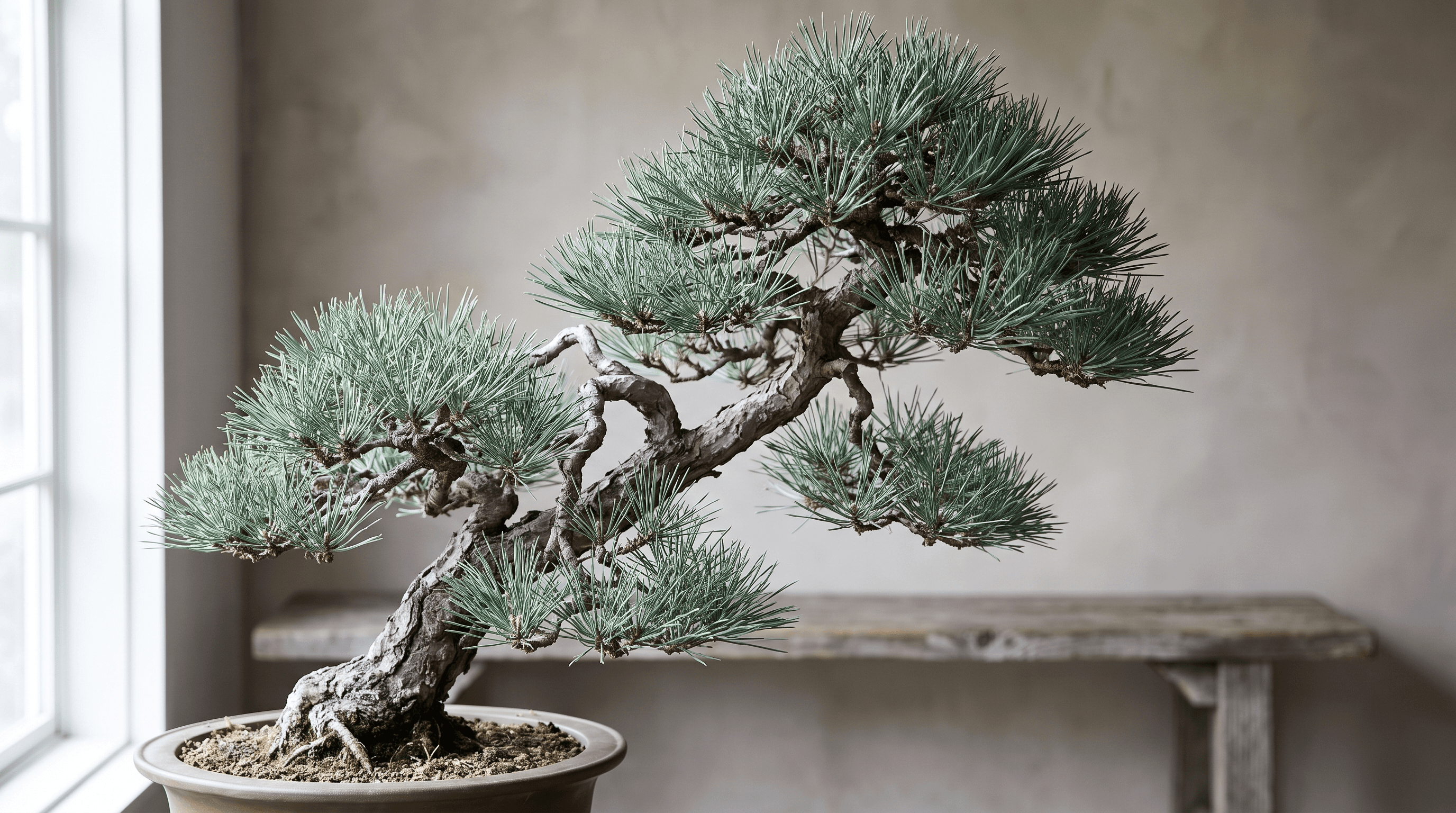
White pine holds a place in Japanese bonsai that's hard to overstate. Some of the oldest, most celebrated bonsai in existence are white pines, and there's a reason the species keeps showing up at the top of the tradition: the needles are short, fine, and carry a soft blue-green cast that gives the whole tree a gentler, more contemplative look than the bold, masculine presence of a black pine. Where black pine reads as power, white pine reads as elegance, and growers tend to reach for it when they want a tree that feels quiet and refined rather than dramatic.
One thing worth knowing early, because it shapes how you'll actually acquire and care for a tree: a lot of white pine bonsai in cultivation, particularly older or more developed material, is grafted onto black pine rootstock. White pine on its own roots can be slower and, in some conditions, less vigorous than a grafted tree, so growers have long used black pine's tougher root system to give a white pine top the strength it needs. If you own a grafted tree, it's worth knowing where the graft union sits on the trunk, since that area needs a bit of extra care and attention over the years, particularly at repotting time.
The technical piece that trips people up most, though, is candle work. White pine is a single-flush species. It doesn't get decandled the way black pine does, and cutting candles back hoping for a second flush the way you would on a black pine generally just weakens the tree without producing the refinement you're after. What white pine actually wants depends more on vigor and refinement stage than a lot of care guides let on. The safer general approach, and the one I default to, is to let the spring candle extend and harden fully, then prune once the needle sheaths have dropped, roughly early to mid-summer, rather than cutting into soft spring growth. Some traditional systems do selectively shorten a very strong spring candle before it hardens, so spring work isn't automatically wrong, but post-hardening pruning is the framework that holds up across the widest range of trees. Learn that distinction properly and white pine becomes one of the most rewarding conifers you can develop; skip it and graft black pine's decandling logic onto this species, and you'll spend years working against it rather than with it.
Care
Light
White pine wants full sun to develop dense, healthy foliage, though in my experience it's a touch less forgiving of the most brutal midday heat than black pine is, especially in a hot, humid summer stretch. A reasonable rule of thumb is around 30% shade once temperatures push past roughly 38°C (100°F), rather than shading preemptively or shading heavily; below that, full sun is what the tree wants. That said, this is a light-hungry tree overall, and too much shade will thin out the foliage and dull the needle color quickly, so any protection should be modest and temporary, not a retreat to a shady corner.
Watering
The same basic rule applies as with any pine: let the surface dry a little between waterings, then water thoroughly, and avoid letting the roots sit constantly wet. White pine roots seem, in my experience, at least as sensitive to poor drainage as black pine's, if not more so. Stress from overwatering tends to show up gradually, as needles that lose their blue-green brightness and start looking dull, rather than as sudden collapse.
Temperature & hardiness
White pine is a hardy species overall, but it generally prefers a cooler, less intensely hot environment than black pine does. It still belongs outdoors year-round with normal winter protection for the pot, and it doesn't need or want to come indoors. If your site runs consistently above roughly 38°C (100°F) through summer, around 30% shade and good airflow around the foliage will serve this species better than leaving it in unbroken full sun; below that threshold, full sun is fine.
Soil & potting
A fast-draining, mineral mix is essential, along the same lines as black pine: akadama, pumice, and lava rock in roughly equal parts is a reliable baseline, and airflow around the roots matters as much here as anywhere in the pine family. White pine also benefits from the mycorrhizal relationships that build up in the soil over time, so carrying a portion of the old mix forward at each repotting helps maintain that fungal community rather than starting sterile. On a grafted tree, remember that the entire root system belongs to the black pine rootstock, not the white pine scion above it, so root vigor and repotting response track the rootstock's habits rather than the top growth's.
Fertilizing
Because white pine is single-flush, its fertilizing schedule is steadier through the season than a decandled black pine's, without the deliberate pause-and-resume built around a candle cut. A balanced feed from spring through early autumn, tapering as growth slows, suits this species well. Where candle selection and thinning are done in spring, some growers ease feeding slightly around that work too, similar in spirit to how black pine growers manage decandling, though the swing is generally gentler since there's no full second flush being forced.
Pruning & wiring
This is the section where white pine most needs to be understood on its own terms rather than as a lighter version of black pine. White pine does not get decandled. It's a single-flush species: it pushes one round of candles in spring, and that's the growth you work with for the year. Where I'd correct a common oversimplification is treating spring candle shortening as the standard white pine technique, the way you might shorten candles on a younger tree of almost any conifer. The more reliable modern approach, the one I lean on for most trees, is to let the spring candle extend and harden fully, then prune once the needle sheaths have dropped, typically early to mid-summer. That's different from black-pine decandling and different from indiscriminate spring pinching too; you're working with growth that's already hardened rather than interrupting it mid-extension. That said, some traditional systems do selectively shorten a very strong spring candle before it hardens to keep one shoot from dominating a whorl, so spring work isn't universally wrong, it depends on the individual candle's vigor and where the tree sits in its development. Needle work is more conservative on this species than on black pine: rather than plucking through the growing season, the safer approach is removing some of the older needles by hand once a shoot has matured, which opens the canopy to light and helps balance strong areas against weak ones without stressing a tree that's still building energy. If you take black pine's decandling approach and try to apply it here, cutting candles back hoping for a second flush, you're generally just removing the year's growth without triggering the response you'd get from a true two-flush species, and a repeatedly mishandled tree can lose vigor over a few seasons. For wiring, white pine's bark is thinner and smoother than black pine's, especially on younger material, so it scars more easily and needs a gentler touch and closer monitoring as branches thicken. Work on hardened, not fresh, growth, and in the cooler months as with other pines.
Repotting
White pine is repotted on a similar interval to black pine, often every three to five years for an established tree, in early spring as buds begin to swell. Root work should be conservative, clearing old soil from the outer portion of the root mass rather than aggressively bare-rooting, since the mycorrhizal relationships this species relies on take time to rebuild. On a grafted tree, take extra care around the graft union during root work and repotting, since that area is a genuine structural and vascular junction between the black pine rootstock and the white pine scion above it, and it's worth handling gently rather than treating the whole root mass uniformly.
Common problems
Needle discoloration is the most common issue, and the causes overlap with black pine: soil staying too wet, roots disturbed too aggressively at the last repot, or insufficient light. Good airflow around the foliage and avoiding overly dense, unthinned growth helps guard against fungal needle problems in hot, humid conditions. Aphids show up from time to time, generally on fresh candles in spring. On grafted trees, watch the union itself; a swelling, cracking, or dieback right at that point is worth investigating rather than dismissing, since it's the structural weak point of a grafted specimen. A tree that consistently produces long, weak candles rather than short, even ones can point to several different things, among them light, root health, watering, and overall nutrition, so it's worth checking the basics rather than assuming a single cause.
Styling
White pine is prized for elegance and fine ramification rather than raw power, and the styling choices tend to reflect that. Formal and informal upright work well, but so does literati, since white pine's naturally soft, layered foliage suits a slender, expressive trunk line as well as it suits a bold one. Because the needles are short and fine, white pine tolerates dense, tightly built pads at a smaller scale than black pine does, which is part of why it's such a popular choice for medium and smaller bonsai sizes where fine detail actually reads. Deadwood is used less dramatically on white pine than on black pine; the species leans toward a quieter, more contemplative image, and most growers favor restrained, tasteful jin over heavy dramatic deadwood, letting the foliage and trunk movement carry the composition.
Common questions
Do you decandle Japanese white pine like black pine?
No, and this is the single most important thing to get right with this species. White pine is single-flush, not two-flush like black pine, so decandling doesn't produce a useful second flush here. The modern approach most growers rely on is letting the spring candle extend and harden, then pruning after the needle sheaths drop, roughly early to mid-summer, rather than working the candle while it's still soft. Applying black pine's decandling technique to white pine tends to weaken the tree without giving you the refinement you're after.
What's the real difference between white pine and black pine technique?
Black pine is two-flush and gets decandled in early summer to force a second, more refined flush of growth. White pine is single-flush and is generally managed by letting the spring candle extend and harden, then pruning after the needle sheaths fall, which is neither decandling nor simple spring candle-shortening. The two techniques don't transfer between species; treating white pine like a lighter black pine, or like a tree that just needs its candles pinched every spring, is one of the most common mistakes beginners make with this tree.
Why is my white pine grafted onto black pine roots?
It's a common and long-standing practice in Japanese bonsai. White pine on its own roots can be less vigorous than a grafted tree, so black pine's tougher, more vigorous root system is often used as rootstock to support a white pine top. If your tree is grafted, take extra care around the graft union, particularly during repotting and root work.
Is white pine harder to grow than black pine?
In some respects, yes. It can be a touch more sensitive to intense heat, and if it's grafted there's an added structural consideration at the union that black pine doesn't have. It's not fragile, but I'd generally point a true beginner toward black pine first and bring white pine in once you've got some pine experience.
Why are my white pine's needles losing their blue-green color?
Usually it comes down to soil staying too wet, root disturbance from a recent repot, or not enough light, the same short list as most pines. In humid conditions, also check for fungal needle issues, since dense, unthinned foliage and poor airflow both encourage them. Good airflow around the foliage helps prevent this.
When do I prune a white pine's candles?
The safer general approach is to let the spring candle extend fully and harden, then prune once the needle sheaths have dropped, which usually lands in early to mid-summer depending on climate. At that point you can shorten or remove the strongest shoots and thin crowded areas to leave a more even spread of moderate shoots across the tree. Some traditional systems do selectively shorten an unusually strong candle earlier, while it's still soft, to stop it from dominating a whorl, but that's a targeted move for a vigorous shoot rather than a blanket spring technique, and post-hardening pruning is the framework that works reliably across most trees.
General guidance based on 20+ years of practice. Every tree and every climate is different — when in doubt, ask us.