
Shimpaku Juniper Bonsai
Juniperus chinensis 'Shimpaku'
Shimpaku is the juniper most serious growers reach for first, and once you've worked with its foliage and its deadwood side by side, it's obvious why: nothing else in the genus combines that density of fine growth with wood that carves so cleanly.
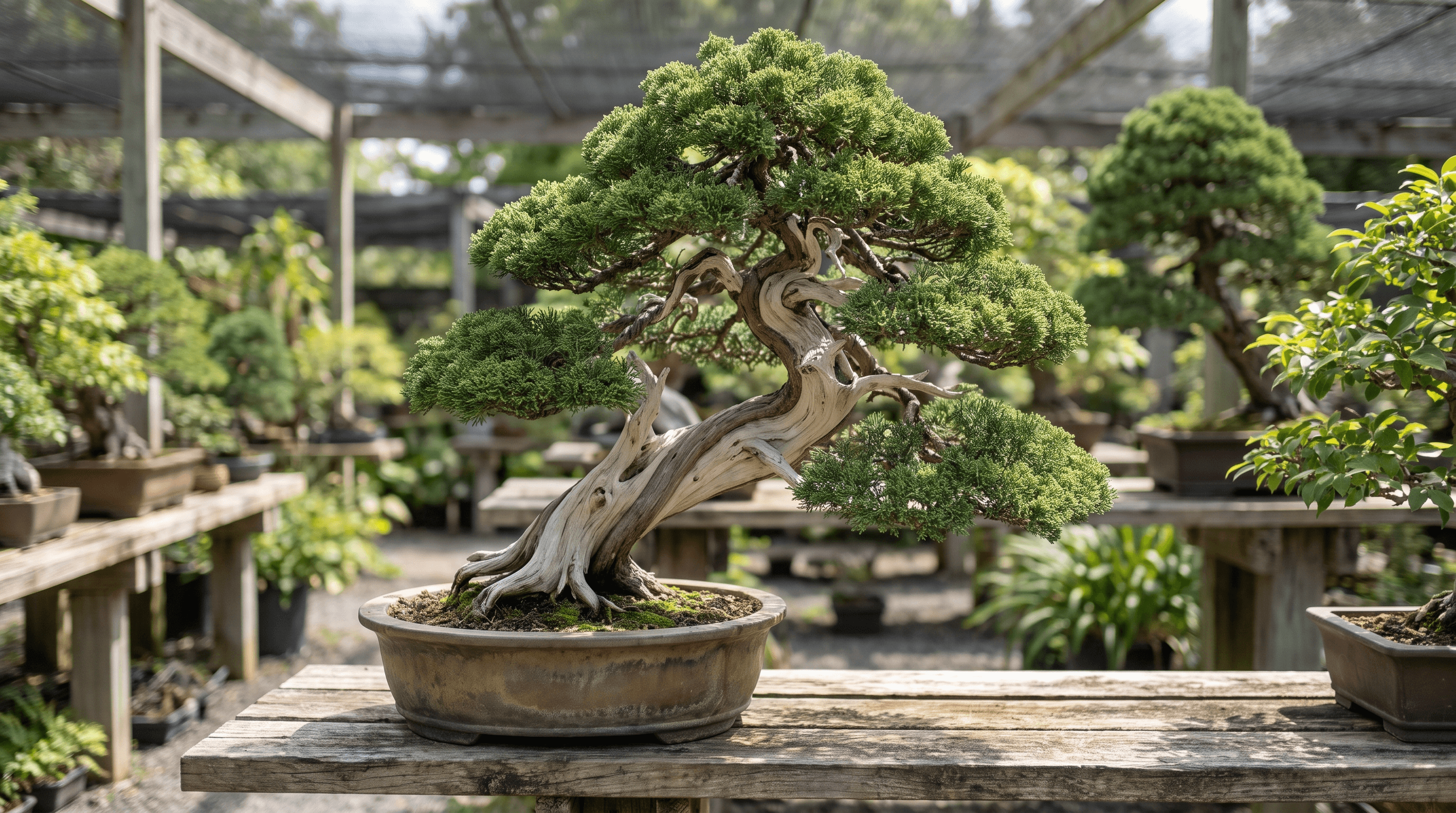
Shimpaku is best understood as a traditional bonsai form of Chinese juniper, generally associated with Juniperus chinensis var. sargentii, rather than a separate species, and it's worth saying that plainly because a lot of nursery tags blur the line. What sets it apart from ordinary Juniperus chinensis stock is the foliage: tight, soft, scale-like sprays that pack closely together and give a mature specimen that dense, cloud-like canopy people associate with the best Japanese bonsai. Compare it to a generic chinensis seedling and the difference is immediate, the Shimpaku sits denser and finer almost from the first year of training.
I've grown Shimpaku alongside its own siblings, Itoigawa and Kishu, on the same bench for years, and the honest answer is that Shimpaku sits in the middle of that family for foliage fineness, not at the top. It's finer than plain chinensis but a touch coarser than Itoigawa. Shimpaku's wood is dense and resinous and takes jin and shari work beautifully, holding fine detail under a carving knife, and Itoigawa is also excellent for deadwork, the two are closer on that front than growers sometimes assume. What Shimpaku reliably offers is good living foliage and strong deadwood potential on the same tree, which is a big part of why it's stayed a staple of high-end collections.
It's also commonly propagated from cuttings, though grafted specimens are widespread too, whether onto vigorous nursery-grown juniper stock or onto collected juniper trunks with good movement already in place. Grafting isn't limited to chinensis rootstock either, growers also graft Shimpaku foliage onto prostrata, California, Sierra, and Utah juniper stock among others. None of this is a flaw, it's standard practice and can give you vigorous roots under refined foliage, but it does mean you should know what you're buying and expect to manage a graft union as the tree develops if your specimen is grafted.
Care
Light
Full sun outdoors, same as any juniper, and Shimpaku actually rewards strong light more visibly than some other cultivars because its foliage density depends on it. Grow it in too much shade and the fine, tight sprays start to open up and elongate, losing the compact look that's the whole reason people choose this cultivar over a plain chinensis. If you're training a Shimpaku specifically for refined ramification, err on the side of more sun rather than less, and rotate the pot occasionally if one side of the bench gets more direct exposure than the other.
Watering
Water thoroughly when the top of the soil starts to dry, then allow the substrate to dry slightly before the next watering rather than keeping it constantly damp. Shimpaku's dense foliage mass actually makes it a little harder to judge by looking at the surface alone, since a thick canopy shades the pot and slows visible drying, so I check by feel or with a moisture probe rather than trusting appearances on a well-developed specimen. Overwatering in a slow-draining mix is the more common failure here, and it shows up as dieback in patches of the canopy rather than the whole tree browning at once.
Temperature & hardiness
Shimpaku is a genuinely cold-hardy conifer and, like all junipers, needs real winter dormancy outdoors to stay healthy long-term. Don't treat it any differently than other juniper material on this point, bright indoor spots are not a substitute for actual cold and seasonal light changes. Roots in a bonsai pot have much less insulation than the same tree would have planted in open ground, so cold protection is still worth providing in severe freezes, roughly -10°C and below, even though the species itself is very hardy overall. Keep the tree outside through the season regardless.
Soil & potting
A fast-draining, mineral mix works best, akadama, pumice, and lava rock in roughly even parts, or a locally sourced equivalent of coarse, inorganic particles. Shimpaku's fine root system responds well to a mix with good aeration, and because the foliage is so dense it can be harder to spot early drainage problems from the canopy alone, so err toward a slightly more open mix than you might use for a coarser-foliaged juniper.
Fertilizing
Feed through the growing season with a balanced or slightly nitrogen-forward fertiliser, then stop as growth slows into autumn. Reversion toward coarser, juvenile-looking foliage is something Shimpaku owners run into, but it's driven mainly by hard pruning or other significant stress to the tree rather than by feeding on its own, so there's little reason to starve a healthy tree just to hold the foliage tight. I keep feeding moderate rather than generous on refined specimens and increase it only when I'm deliberately trying to thicken a trunk or push vigor on younger material, not on a tree I'm trying to keep tight.
Pruning & wiring
Let healthy shoots extend through the season, then selectively prune overly long runners with sharp scissors, cutting back to a suitable lateral shoot or deeper within the foliage. Avoid repeatedly pinching every growing tip or shearing the pads like a hedge, both practices can weaken the tree and leave browned foliage, which is a more visible loss on a cultivar prized for foliage density. Thin out overly dense interior growth occasionally too, since Shimpaku pads left unmanaged for a season or two can bulk up on the outside and shade out the interior, which then dies back and leaves gaps. Wiring is where Shimpaku genuinely excels, the branches take a bend cleanly and hold it, which is part of why the cultivar is so associated with dramatic literati and cascade lines. Wire during cooler months, check regularly as branches thicken, and if you're doing deadwood work on jin or shari, this is a cultivar where that investment of time tends to pay off, since the wood carves and bleaches cleanly and holds fine detail for years.
Repotting
Repot in early spring, roughly every two years on younger, actively growing material and less often as the tree matures. Work the outer root mass gently rather than bare-rooting, and get the tree back into a fast-draining mix immediately. If your specimen is grafted, take a look at the union while you're in there, it should be knitting cleanly with no separation or excess callusing, and a healthy graft shouldn't need any special treatment beyond normal aftercare of a sheltered spot and reduced watering stress for a couple of weeks.
Common problems
The most Shimpaku-specific problem I see isn't disease, it's foliage reversion, where a tree that was grown tight and fine starts throwing coarser, more open juvenile-looking growth after hard pruning or another significant stress to the tree. It's not fatal, but it does mean letting the tree grow strongly again, allowing shoots to extend before selectively pruning with scissors, to bring the mature foliage character back. Beyond that, Shimpaku shares the usual juniper vulnerabilities: spider mites in hot, still, dry conditions, especially inside a dense canopy where airflow is poor, and browning that traces back to either watering trouble or a graft union that hasn't taken well on grafted stock. A sudden dead patch localized to one section of foliage, rather than the whole tree, is worth investigating at the branch level before assuming a wider problem.
Styling
Shimpaku is the cultivar most associated with the dramatic, twisted literati and semi-cascade forms that people picture when they think of high-end Japanese bonsai, largely because the trunk and branches wire so predictably and the deadwood work holds such fine detail. Formal and informal upright styles work too and let the dense, cloud-like foliage pads do the talking without competing with heavy jin or shari, which suits younger or less dramatic material well. Where Shimpaku really separates itself from other junipers is in combining refined, healthy foliage with extensive deadwood on the same tree, an aged Shimpaku with strips of bleached shari running up a living, densely-foliaged trunk is about as classic an image of bonsai as exists, and it's the reason collectors pay a premium for good specimens over other chinensis cultivars.
Common questions
Is Shimpaku juniper a good species for a beginner?
It's a reasonable choice if you can give it real outdoor conditions with a genuine winter, but it's not the easiest juniper to start with. Because it's often grafted or takes a season or two to establish, and it's prized for fine ramification, a lot of the specific techniques that make Shimpaku special, selective scissor pruning, reading the foliage, deadwood work, are more intermediate skills. A plain chinensis or procumbens nana is a gentler entry point.
What's the difference between Shimpaku and regular Chinese juniper?
Shimpaku is a traditional bonsai form of Chinese juniper, generally associated with Juniperus chinensis var. sargentii, rather than a separate species, selected and grown for denser, finer, softer scale foliage than a typical seedling-grown chinensis. Its wood is also well suited to deadwork. Shimpaku is commonly propagated from cuttings, though grafted material is widespread too, combining vigorous rootstock with refined top growth.
Why is my Shimpaku's foliage turning coarse and spiky?
This is usually reversion toward juvenile-type growth, most often triggered by hard pruning or another significant stress to the tree rather than by feeding or shade alone. It's not disease and it's reversible, let the tree grow strongly again and selectively prune overly long shoots with scissors rather than pinching every tip, and mature scale foliage usually returns, though it can take a season or more to fully tighten back up.
Can Shimpaku juniper be used for deadwood and jin work?
Yes, and it's genuinely one of the best juniper cultivars for it. The wood is dense and resinous, carves cleanly, and holds fine detail well after bleaching, which is a big part of why Shimpaku is so favored for advanced, dramatic bonsai styling compared to coarser junipers.
Is a grafted Shimpaku juniper worse than one grown on its own roots?
Not inherently. Shimpaku is propagated from cuttings as often as it's grafted, and grafting onto vigorous juniper rootstock is standard, accepted practice rather than a shortcut to avoid. Grafting is common and isn't a quality defect on its own. If your specimen is grafted, just check the union periodically for clean healing, and know that with age it usually becomes far less visible as the trunk thickens around it.
How is Shimpaku different from Itoigawa juniper?
Both are closely related forms of Juniperus chinensis, but Itoigawa generally holds an even finer foliage texture than Shimpaku. That fineness comes with a tradeoff, Itoigawa actually tends to throw juvenile, needle-like growth more readily than Shimpaku after hard pruning or stress, not less, so it isn't the more forgiving option it's sometimes made out to be. Both cultivars are excellent for deadwood carving, so the choice often comes down to foliage texture and color preference for a given tree rather than either trait being clearly superior.
General guidance based on 20+ years of practice. Every tree and every climate is different — when in doubt, ask us.