
Kishu Juniper Bonsai
Juniperus chinensis 'Kishu'
Kishu is the juniper I reach for when someone wants a shohin or small bonsai that still looks convincingly aged, because the foliage is tight and fine enough to stay in scale even on a tree you can hold in one hand.
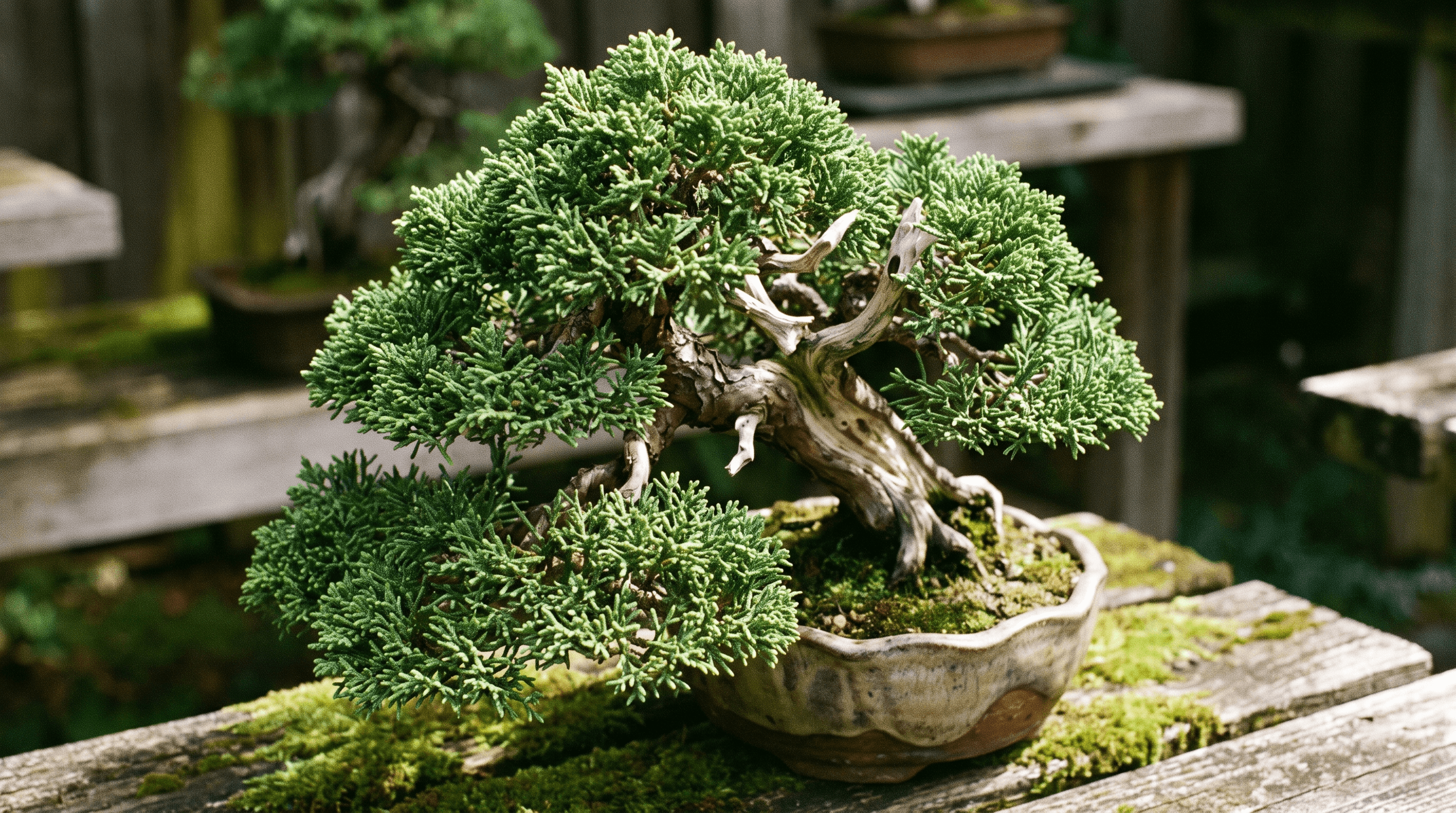
Kishu gets grouped with Itoigawa and Shimpaku a lot, and people assume the differences are cosmetic. They're not, at least not for how the tree behaves on the bench. What sets Kishu apart is density: the scale foliage naturally forms dense, compact sprays with relatively short extension growth, which makes refinement easier than on many coarser Chinese juniper cultivars and helps a Kishu start looking like a miniature mature tree sooner than most others. Compared with Itoigawa, which tends toward finer, brighter, more open foliage, Kishu is generally stouter, denser, and more compact. That density is exactly why the cultivar is especially well suited to shohin and mame sizes, though it's also grown successfully on larger trees, it isn't only a small-tree cultivar.
Kishu also tends to remain denser and more compact than vigorous, unnamed Chinese juniper stock, and it may take longer to build trunk mass when grown for development, though actual growth rates vary with vigor, feeding, and light rather than following a fixed rule. It's readily propagated from cuttings and often grown as young material, so don't assume every Kishu on the bench has to start from grafted or already-thick trunk stock. If you bought a Kishu expecting rapid extension growth to build a bigger tree quickly, you'll be disappointed. If you bought it because you want tight, refined foliage pads on a small tree, it's one of the best cultivars available for that.
Care
Light
Full sun, same as any juniper, and Kishu handles it without complaint. Because the foliage is so dense, light penetration and airflow through the interior matter more here than on a coarser juniper, so give Kishu good sun and space rather than crowding it against other trees on the bench; dense pads in tight, shaded spacing can shade their own interior surprisingly quickly and contribute to weakening there. Shade thins the exterior foliage too and loosens the compact habit that's the whole point of growing this cultivar in the first place.
Watering
Small pots dry out fast, and shohin-sized Kishu is often grown in genuinely small containers, so check the soil daily through the warmer months rather than assuming a schedule will hold. Water thoroughly when the surface starts to dry, and don't let a small pot sit bone dry on a hot afternoon, since the root mass in a shallow shohin pot has very little buffer. At the same time, avoid a mix that stays wet for days, since the dense foliage can hide early root problems for longer than you'd like before they show up as dieback.
Temperature & hardiness
Kishu is a genuinely cold-hardy cultivar and needs a real outdoor winter with proper dormancy, same as other junipers. The one adjustment worth making is for pot size: small shohin containers offer less insulation for the roots than a larger pot, so in a hard freeze I give these extra protection, grouping pots together, mulching around them, or moving them into an unheated shelter rather than leaving a tiny pot fully exposed. The tree itself tolerates cold well; it's the small root mass in a small pot that's more vulnerable.
Soil & potting
A fast-draining, mineral mix is essential, and for shohin-sized Kishu I'd lean toward a slightly finer particle grade than you'd use on a larger juniper, since a smaller pot needs the mix to hold just enough moisture between waterings without staying wet. Akadama, pumice, and lava rock in even parts, sieved to a smaller grade for the pot size, works well. Good drainage matters just as much here as on any other juniper; a compact root system in a small pot has even less tolerance for standing water.
Fertilizing
Feed through the growing season with a balanced or slightly nitrogen-forward fertiliser, but go easy on concentration for shohin-sized trees in small pots, since it's easier to overdose a small volume of soil than a large one. Diluted liquid feed applied more often, roughly weekly during active growth, gives you better control than infrequent heavy doses. Stop as growth slows into autumn and skip feeding through winter dormancy.
Pruning & wiring
This is where Kishu's density becomes an advantage. The tight internodes mean you can build compact foliage pads with less work than on a coarser cultivar. Let healthy shoots extend, then selectively prune overly long runners with sharp scissors, cutting back to a lateral shoot or deeper into the foliage; avoid repeatedly pinching every tip or shearing like a hedge, both weaken the tree and brown the foliage. For structural work, wire in the cooler months when branches are flexible, and because Kishu is often grown at smaller sizes, use finer wire gauges than you would on a larger juniper and check more frequently, since thin shohin branches thicken relative to the wire faster than the numbers suggest. As always, leave live foliage on any branch you're reducing rather than cutting back to bare wood.
Repotting
Younger, actively growing Kishu in training pots benefits from repotting roughly every two years; mature shohin specimens that have slowed down can go longer between repots. Do this in early spring before new growth starts. Because shohin pots are shallow and the root mass is compact, work gently and methodically around the root ball rather than aggressively raking it out, and get the tree back into a fast-draining mix straightaway. Give it a sheltered, lightly shaded spot for the first couple of weeks afterward before returning it to full sun.
Common problems
The density that makes Kishu attractive also makes problems harder to spot early, since thick foliage pads can hide browning or dieback in the interior of the pad until it's fairly advanced. Get in the habit of parting the foliage occasionally to check the inner growth, not just the surface. Spider mites are a real risk in hot, still conditions, and because the foliage is so tight, an infestation can spread through a pad before it's obviously visible from outside. Watering problems show up faster in small pots than large ones, so if you see general thinning or browning, check your watering consistency and the root ball before assuming disease. Kishu's compact habit can make progress look slower than on vigorous nursery Chinese juniper, but a tree producing virtually no extension through an entire growing season should be checked for root, light, pest, or watering problems rather than written off as just the cultivar's nature.
Styling
Kishu's tight, compact foliage is best suited to refined, detailed styling rather than dramatic sweeping lines, which is why it's such a common choice for shohin and mame trees where every foliage pad is visible up close. Formal and informal upright styles let the dense pads read clearly. Healthy Kishu can produce useful interior and occasional older-wood buds when light reaches the branch, which helps you develop layered branch structure over time, but don't design a tree assuming completely bare wood will reliably backbud; grafting may be necessary when foliage is too far from the trunk. Deadwood work is still very much in play, jin and shari read well against the fine scale foliage and give even a small tree a sense of age, but on this cultivar I'd keep deadwood proportionate and restrained rather than heavy-handed, since an oversized dead feature can overwhelm a small, delicate tree.
Common questions
What makes Kishu juniper different from Shimpaku or Itoigawa?
Mainly foliage density. Kishu naturally produces dense, compact scale foliage with relatively short extension growth, and compared with Itoigawa, which tends toward finer, brighter, more open foliage, Kishu is generally stouter and denser. That's what makes it so well suited to small and shohin-sized bonsai. Shimpaku is the more traditional, widely available option for larger material. All three are Juniperus chinensis cultivars and share the same basic care needs.
Is Kishu juniper good for shohin bonsai?
Yes, it's one of the better choices available, and its dense foliage makes it especially well suited to shohin and other small bonsai, though it's also grown successfully on larger trees. The dense, fine foliage stays in proportion even on very small trees, which is exactly the problem coarser junipers run into at shohin size. Trunk mass may take longer to build than on more vigorous stock, but Kishu is readily grown from young material rather than needing to start from already-thick trunks.
Why is my Kishu juniper growing so slowly?
Slow, compact growth is largely normal for this cultivar, it's part of what makes the foliage stay so tight and fine. If growth has stopped entirely for a full season rather than just being slow, check watering consistency, light levels, pests, and the root ball, since a stalled tree with genuinely no new growth points to a problem rather than the cultivar's natural habit.
Can I keep a Kishu juniper in a very small pot year-round?
Yes, that's normal for shohin material, but small pots need closer attention. Check soil moisture daily in the growing season, since a small root mass has little buffer against drying out, and give extra winter protection in hard freezes, since a small pot offers less insulation to the roots than a larger container.
How do I keep the foliage pads tight on a Kishu juniper?
Consistent full sun and disciplined growth management through the season. Let healthy shoots extend, then selectively prune overly long runners with sharp scissors, cutting back to a lateral shoot or deeper into the foliage, rather than pinching every tip or shearing like a hedge, both weaken the tree and brown the foliage. Kishu's naturally compact growth does a lot of the work for you, but shade or neglecting this maintenance will still loosen the pads and make them look leggy over time.
Does Kishu juniper need different soil than other junipers?
The same principle applies, a fast-draining, mineral mix, but for shohin-sized trees in small pots I'd use a slightly finer particle grade than you would on a larger juniper, since the mix needs to hold a bit more moisture relative to pot volume without ever staying waterlogged.
General guidance based on 20+ years of practice. Every tree and every climate is different — when in doubt, ask us.