
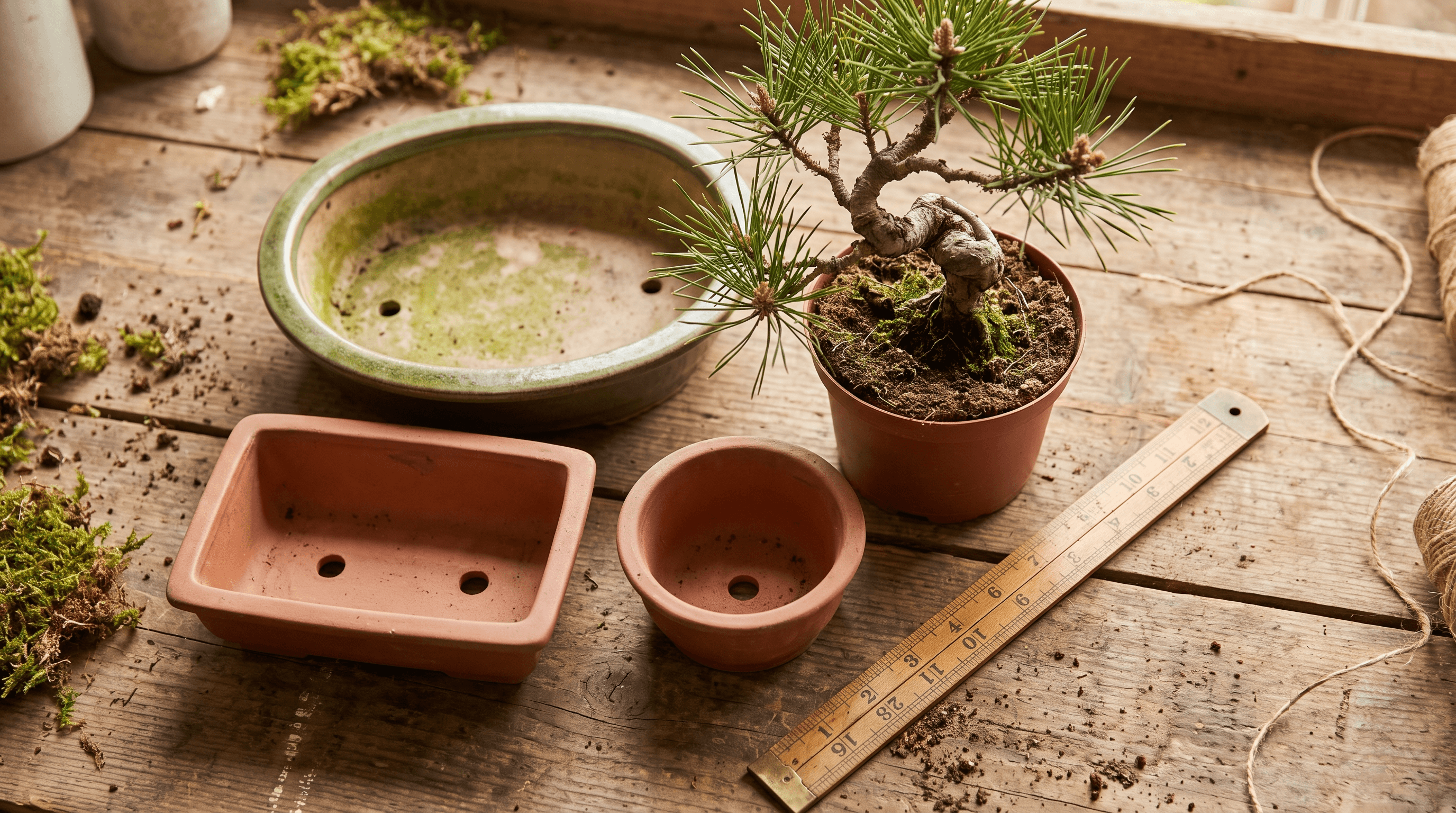
I get some version of this question almost every week: someone has a tree they like, they've found a pot they like, and they want to know if the two belong together. Most of the time the pot is wrong, and almost always it's wrong in the same direction. It's too big.
A pot that's too large doesn't just look off. It can hold more soil than the roots are using, which stays wet longer, and in the wrong soil mix or a wet climate that's one of the more common paths to root rot. Sizing the pot correctly isn't only a display formality. Done badly, it works against the tree.
Everything below is about a finished display bonsai. If your tree is still young nursery stock or pre-bonsai under development, it wants a larger training container instead, not these proportions; I cover that separately further down.
What size pot for bonsai: two numbers, judged against your tree
Pot size comes down to two separate measurements, depth and length, and both should be judged against your specific tree rather than read off a fixed chart. Here's how I work out each one, with real numbers, and where the rules of thumb stop applying.
The trunk-diameter rule
The classic starting point, and the one I still use myself, is this: measure the trunk diameter just above the roots, and the pot's depth should be roughly equal to that measurement. That's a visual proportion, not a precise engineering figure; the usable root depth inside the pot matters horticulturally too, and I check both rather than treating the outside measurement as the whole answer.
In practice: a trunk around 2cm across suits a pot roughly 2-3cm deep. A trunk around 5cm across suits something closer to 5-7cm. A thick, mature trunk near 10cm can carry a pot 8-10cm deep. These are starting ranges, not fixed answers, and they bend for style and for the tree's own vigor and root habit, which I'll get to.
Length follows the canopy, not the trunk
Length here means the pot's longer dimension, the one you see left to right when the tree faces you, not its depth. The usual guideline is around two-thirds of the tree's height for an upright tree taller than it is wide, or around two-thirds of the canopy's spread if the tree is wider than it is tall. So a 40cm-tall upright tree suggests a pot length near 25-28cm, while a broad, spreading tree only 30cm tall but 50cm across suggests a pot closer to 33-35cm long, following the spread rather than the height. Neither figure is exact. I treat both as a range to stay inside, not a target to hit precisely.
What matters more than either measurement is the visual weight. Stand back from the tree and the pot together. If the pot pulls your eye before the tree does, it's too big. If the tree looks like it's about to tip out, it's too small.
A quick way to check yourself
- Measure trunk diameter just above the nebari (the root flare at the base).
- Pick a pot whose depth is close to that number, then adjust for style (see below).
- Check the pot's length against roughly two-thirds of the tree's height, or two-thirds of the canopy's spread if the tree is wider than it is tall.
- Step back and look at the two together. Trust your eye over the numbers if they disagree.
- Whatever you pick, make sure the pot drains well and has proper tie-down holes. A well-sized pot with poor drainage still causes the same root problems you're trying to avoid.
How style changes the answer
The trunk-diameter rule assumes an upright tree, and most styles depart from it in a fairly predictable direction:
- Formal and informal upright trees are closest to the base rule: depth near the trunk diameter, a rectangular or oval pot.
- Cascade and semi-cascade trees need real depth, usually well beyond the trunk-diameter figure, because the pot has to physically and visually anchor a tree that's falling away from it. There's no fixed multiple I'd trust here. I size these by stability and by eye more than by formula.
- Group plantings and forest styles go the other way: wide and shallow, sometimes a simple slab, because the point is the ground plane the trees are standing on, not the depth of the container.
- Literati style, with its long bare trunk, usually takes a small, almost incidental pot. The tree is meant to dominate; the container should nearly disappear.
Development pots vs. display pots
Young trees still being trained don't go in their final pot. I keep developing material in a larger training container, sometimes a deep grow box and sometimes a wide, relatively shallow one. A wider box encourages the lateral roots that build a good nebari, while more root room generally supports the stronger, more vigorous growth that drives trunk thickening over time. Which one I reach for depends on what the tree needs to develop next. Moving a tree into a shallow, elegant display pot too early slows all of that down for years.
The move to a display pot comes later, usually once the trunk has thickened to something close to its intended final size and the nebari has started to spread. That's the point where a pot stops being a growing container and starts being part of the composition.
Mistakes I still see
Going too big is the most common one. It can hold excess moisture and invite root problems, though how much of an issue that is depends on your soil mix, drainage, climate, and how carefully you water. Going too small causes its own trouble. A cramped pot dries out fast, especially through a Mediterranean summer, and can push a tree into stress even with careful watering.
The other mistake is choosing depth and length independently, as if they were unrelated decisions. They aren't. A pot that's the right depth but too long for the tree still reads as oversized, because length is what the eye notices first.
When in doubt, on a finished tree
If you're choosing between two sizes for a healthy, finished tree and both are horticulturally reasonable for that species and your climate, I'd lean a touch smaller over a touch larger, mainly because it's easier to notice and correct an under-potted tree than to catch an over-potted one before the soil has stayed wet too many times. A slightly snug pot means paying closer attention to watering for a season. An oversized one, in the wrong conditions, can cost you a tree. This isn't a rule to force onto species that genuinely need more root room, like thirsty flowering and fruiting trees, or onto a hot, dry climate where an undersized pot leaves no margin for error. How often repotting itself matters also depends on the tree: mature specimens and many pines and junipers can go considerably longer between repots than young, fast-growing material, since their roots generally develop more slowly.