


About this Kishu juniper on stone bonsai
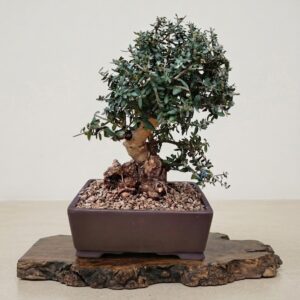
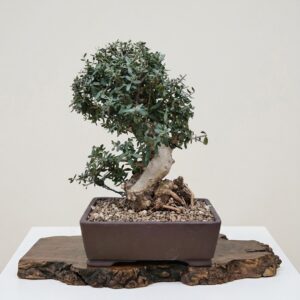
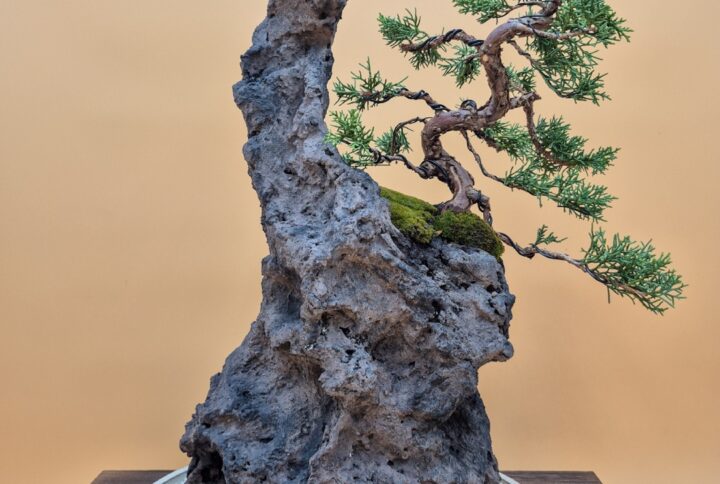
This Kishu juniper on stone bonsai is a substantial composition built around the relationship between a mature juniper and a natural stone. The total visible height of the composition is 75 cm; the juniper itself stands 30 cm tall above the stone, with a 20 cm canopy width. The trunk shows 40 cm of bark circumference — a substantial calibre. The whole composition is set in a 10 × 28 × 38 cm rectangular tray.
Dimensions: Composition height 75 cm · Composition width 71 cm · Juniper height above stone 30 cm · Juniper canopy width 20 cm · Trunk bark circumference 40 cm · Tray 10 × 28 × 38 cm. Photographed in October 2025.
About the cultivar and the on-stone composition
Juniperus chinensis ‘Kishu’ originates from the Kishu area of Japan and is one of the most widely used Shimpaku cultivars in bonsai. The needles are short and soft, the colour is a stable bright green, and the wood develops a clear deadwood character with age. The on-stone style is one of the classical compositional categories in bonsai practice. It mimics what happens to junipers and other coniferous species in mountain environments, where seedlings establish in rock crevices, develop roots that grip the stone over decades, and eventually become small trees rooted in what looks like impossible terrain. Building this composition deliberately is more demanding than growing a tree in a pot, because the root system must be trained to follow the stone and accept a thin substrate layer.
Why choose this specimen
The 40 cm bark circumference of the trunk corresponds to a mature juniper. A trunk this size carried on a substantial stone changes the visual category of the work: this is a display piece rather than a starter tree. The 75 cm overall composition height makes it appropriate for the floor or for a low stand rather than a table. The juniper’s 30 cm of canopy above the stone, at 20 cm wide, gives a compact silhouette that respects the dominant mass of the stone below.
Care and placement
This Kishu juniper on stone bonsai is an outdoor species and stays outdoors all year. Full sun for most of the day keeps the foliage tight. The on-stone composition needs slightly more attention to watering than a tree in a deep pot: the substrate layer on the stone is thinner and dries faster. In summer, check daily and water thoroughly, including a gentle wash over the stone itself. Feed monthly from spring through autumn with a balanced organic bonsai fertiliser, reduced in midwinter. The stone benefits from a light brush every few months to remove algae build-up.
Through the seasons
Spring brings active growth. Pinch new tips through summer by hand to maintain density. Autumn slows growth and deepens the foliage colour. In winter the tree rests; in cooler parts of the country a position protected from prolonged hard frost is advisable, while in warmer parts it winters in a sheltered outdoor spot. The thinner substrate layer makes the tree more vulnerable to deep frost than a tree in a deep pot, so wintering decisions should err on the side of more shelter.
On-stone compositions in European bonsai practice
On-stone compositions are among the more demanding traditional forms in international bonsai practice and remain a comparatively rare presence in European collections. The form requires planning over decades — selecting the stone, training the roots, choosing the tray that contains the composition — and a completed specimen represents a long accumulation of decisions. Collectors who acquire a finished on-stone composition step into a piece whose work is well underway, with the option to take it forward through their own seasons.
Styling and the years ahead
The composition is established. Future work will focus on canopy refinement — pinching, light wiring of secondary branches — and on management of the thin substrate layer with periodic top-dressing of moss. The juniper itself can be repotted from the stone every four to five years if needed, using a free-draining substrate of Akadama, pumice and lava in equal parts retained by a thin sphagnum collar.
Shipping and what you receive
You receive the exact composition shown in the photographs — juniper, stone, and tray together as a single piece. Nothing else is included. The composition is packed individually in a wooden crate sized for the assembled work, and shipped from Italy in one business day. Given the size and weight, this is one of our larger shipments.


&url=https://webonsai.com/product/juniper-kishu-on-stone-height-30cm/&media=https://webonsai.com/wp-content/uploads/2025/09/Juniper-kishu-on-stone-768x1024.jpg)